Executive Summary: WoW: Forever is a beta client that reports itself as mainline while running a Classic-era world, which breaks assumptions in both directions. This is what build 69913 actually exposes — measured in a running client rather than read off a changelog — including the functions that are documented, present at runtime, and still crash the process.
🎧 Listen to the Episode:
This reference accompanies Runtime Reality S26.E0924 — An AI Said the Function Didn’t Exist. It Did. Four Errors in Four Hours. The episode walks the crash model in detail: why C_Housing.GetMaxHouseLevel passes every check reachable from Lua and still takes the client down, and why pcall cannot help.
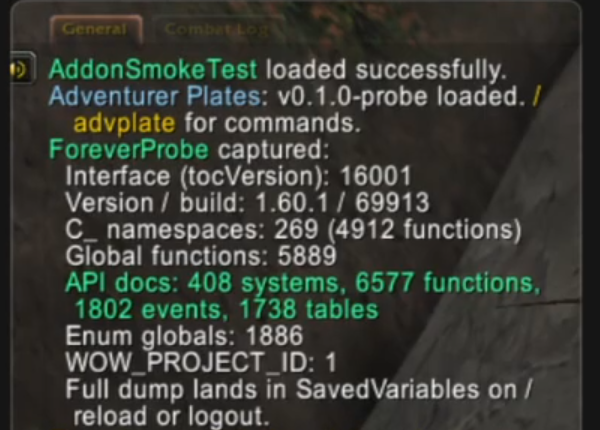
Retail addons find their branches taken and their files missing. Classic addons find their APIs deleted. Everything below was measured on build 69913, Interface 16001 — by walking the global table, by calling things and recording what came back, and by opening an auctioneer. Where a measurement contradicts documentation, the measurement is what is written here.
Both offline sources are structurally blind
Start here, because it invalidates a lot of otherwise reasonable conclusions. There are two ways to ask “does this API exist” without launching the game, and each is blind in a specific way:
An API documentation index covers the C API. FrameXML Lua globals and tables are not in it.
A runtime _G dump typically walks top-level functions and C_* namespaces. Members of plain non-C_ global tables are invisible to it.
Anything Lua-side living inside a global table falls through both. Menu.ModifyMenu is the worked example: documented nowhere, absent from a function-walking dump, and present in the client. A type() check found it in seconds.
So the rule “absent from the index means it does not exist” holds only for the C API. For Menu, UnitPopupMenus, UIDropDownMenu_* and FrameXML helpers generally, nothing short of an in-client check is authoritative.
The capability probe reading its own measurements back, in-client on build 69913.
Existence does not imply safety
This is the finding that most changes how you write code for this client. C_Housing.GetMaxHouseLevel access-violates the client. It is also:
documented in the client’s own API tables, as a no-argument getter, and
present at runtime — it shows up in the _G walk, one of C_Housing‘s 63 functions.
So if C_Foo and C_Foo.Bar then is a nil-guard, not a crash-guard. The crash lives inside a function that passes every test reachable from Lua. And pcall does not help: it catches Lua errors, not access violations. There is nothing to test for in advance.
The only mitigation that works is procedural. Print what you are about to call before calling it, so a hard crash leaves the culprit named on screen. Make the sequence resumable from any step. And never put an unproven call in a save path — SavedVariables are written by the client at /reload or logout, so a crasher there destroys the data it was supposed to persist.
Namespace coverage: the two-way gap
documented C_ namespaces 277
runtime C_ namespaces 269
documented AND present 250
documented, NOT present 27
present, NOT documented ~19
Both directions matter. Twenty-seven documented namespaces do not exist at runtime, so calling into them is a nil index. Roughly nineteen exist with no documentation at all, so their signatures are unknown until you call them — which, per the previous section, is not risk-free.
Legacy globals: gone, kept, and undocumented-but-working
Gone.GetItemInfo, GetSpellInfo, UnitAura, GetAddOnMetadata, UnitPVPRank, GetPVPRankInfo, GetSkillLineInfo, GetNumSkillLines. There is no Classic PvP rank badge to be had; Forever reworked honor, and UnitHonor, UnitHonorLevel and GetPVPLifetimeStats exist instead.
Kept, inconsistently.IsSpellKnown survives while GetSpellInfo does not. Do not infer a pattern; there is not one. Check each name.
Present in _G but undocumented, and all observed returning clean values:
GetProfessionInfo‘s seventh return is the canonical skill-line ID — 165 Leatherworking, 393 Skinning, 356 Fishing — so it is genuinely structured data, not a display string.
GetGuildInfo is worth calling out: C_GuildInfo has 39 functions and not one returns your own guild name or rank. The undocumented global is the only path. GetAchievementInfo returning all-nil lines up with C_AchievementInfo exposing five stubs: achievements are not a player-facing system here.
Native serialisation, and what it actually costs
C_EncodingUtil is present with all ten functions — CBOR and JSON serialisation, Deflate/Zlib/Gzip compression, Base64 and hex, and the inverses. That means no LibSerialize and no LibDeflate, which is a real dependency saving. Measured on a realistic ~380-byte payload:
CBOR 386 B
Deflate 293 B (-24%)
Base64 392 B (+34%)
JSON 517 B (for contrast)
round trip: lossless
chunks: 2 at 240 B
The counter-intuitive part: the Base64 output (392 B) is larger than the CBOR you started from (386 B). Compression is not paying for the encoding. It is paying for the chunk boundary — Base64 of raw CBOR would be about 515 B, which is three chunks instead of two. At this size, Deflate buys you exactly one fewer message.
Base64 output is plain ASCII, which matters more than it looks: addon-message transports reject control characters, so an ASCII-safe payload avoids a whole class of escaping problem.
Model widgets: all six work, including the undocumented one
PlayerModel is not among the 18 documented FrameAPI* widget families. It works anyway.
widget documented 24 legacy camera 15
PlayerModel 24/24 15/15
DressUpModel 24/24 15/15
CinematicModel 24/24 15/15
TabardModel 24/24 15/15
Model 24/24 15/15
ModelScene 0/24 1/15
Five types share an identical surface, and nothing documented was missing on any of them. ModelScene carries none of it, which is correct — it is a scene that hosts actors rather than a model itself. The full legacy camera set is present: SetCamera, SetPosition, SetFacing, SetLight, SetCustomCamera, SetPitch, SetViewTranslation.
Two practical traps. A hidden model frame will not load geometry — call SetKeepModelOnHide(true) before SetUnit, or SetUnit returns false with display ID 0 and you will misdiagnose it as a client limitation. And CanSetUnit is not a predicate here: its documented signature lists no return value, and it returns nil for every token including deliberately invalid ones. Use SetUnit‘s documented boolean instead.
A live 3D portrait on an undocumented PlayerModel widget, rendering correctly once SetKeepModelOnHide is called first.
The auction house is modern, and that matters for addons
Opening an auctioneer with a passive event recorder running produced this:
AUCTION_HOUSE_SHOW 1
AUCTION_HOUSE_BROWSE_RESULTS_ADDED 3
AUCTION_HOUSE_BROWSE_RESULTS_UPDATED 1
AUCTION_HOUSE_NEW_RESULTS_RECEIVED 4
AUCTION_HOUSE_THROTTLED_MESSAGE_SENT 9
AUCTION_HOUSE_CLOSED 1
legacy AUCTION_ITEM_LIST_UPDATE etc. ZERO
Browse queries ran and returned results. Nine throttled round-trips completed. Not one legacy event fired, and C_AuctionHouse has all 85 functions at runtime.
For addon authors this settles which code path is correct. Auctionator, for instance, loads on this client but its AH layer does not — every relevant bundle is gated to game types that omit camelot:
It degrades silently rather than erroring — no Lua errors at all. And because the client fires modern events exclusively, Source_ModernAH is demonstrably the right bundle; Source_LegacyAH would be actively wrong. The toc gating alone could not have told you that, since camelot is missing from both lists.
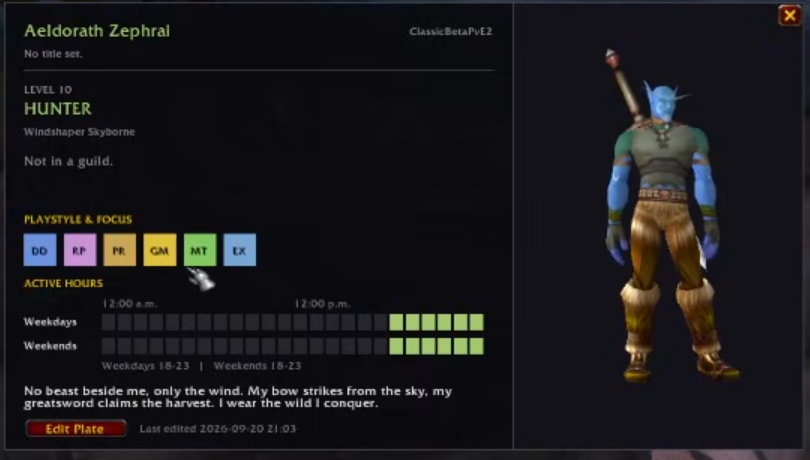
Character names contain a space. Forever has a surname system — C_PlayerInfo.ShouldDisplaySurname exists — so any parsing that splits on whitespace or assumes a single token will break. This matters for layout and for whisper targeting.
New races exist. Skyborne, race ID 96, is not a Classic race. A race-to-icon map built from Classic IDs will not cover it. Also worth knowing: UnitFullName is the only name getter that reliably carries the realm — UnitName("player") returned the name with a nil realm. And C_ClassColor.GetClassColor takes the file name ("HUNTER"), not the localised one.
Confirmed working, for what it is worth
All eight standard frame templates load: BackdropTemplate, UIPanelButtonTemplate, UIPanelCloseButton, InputBoxTemplate, UICheckButtonTemplate, UIPanelScrollFrameTemplate, OptionsSliderTemplate, TooltipBorderedFrameTemplate.
C_ChatInfo has the full addon-message surface including SendAddonMessageLogged, and prefix registration returns Enum.SendAddonMessageResult.Success. Titles work — 111 exist — though GetTitleName returns a fragment with the name’s position implied, so do not splice a name into it blindly.



You must be logged in to post a comment.