
Executive Summary: The “Capital” Identity
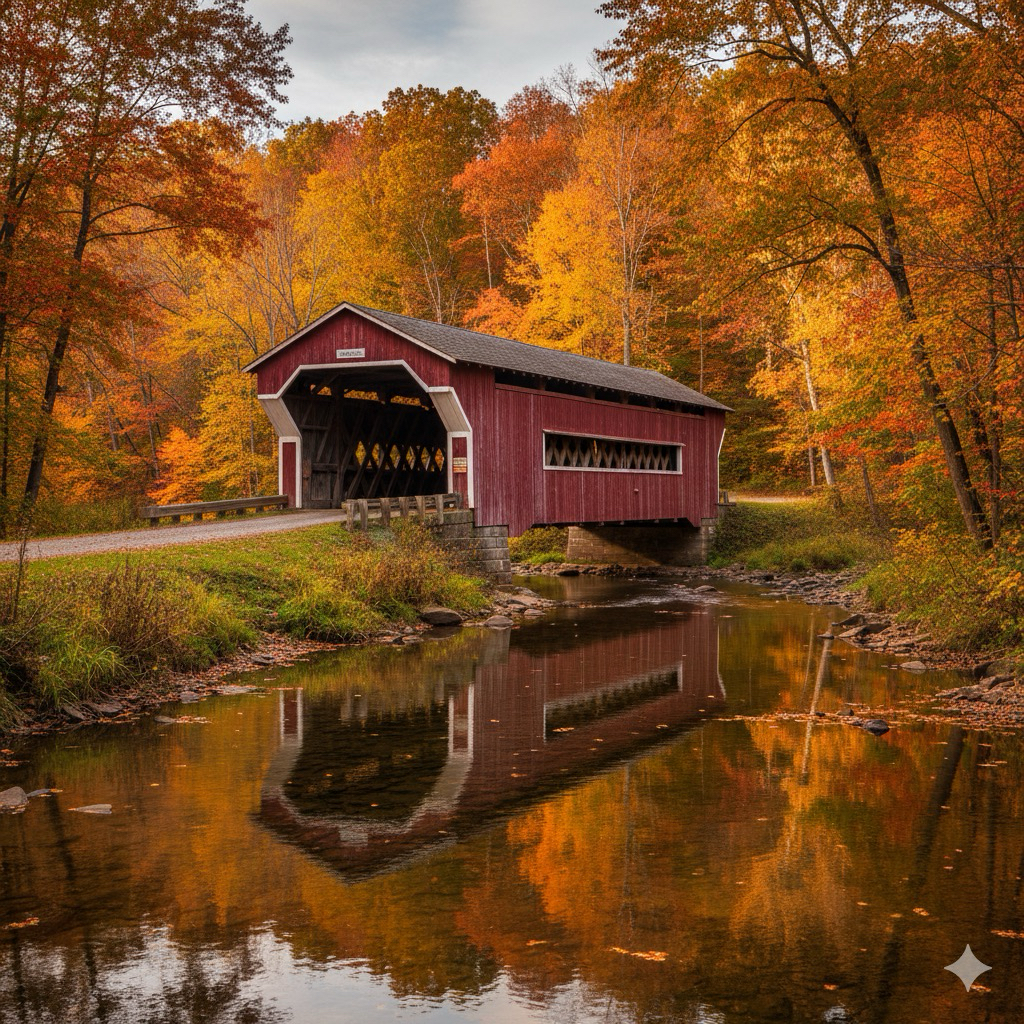
Parke County, Indiana, asserts a bold claim: “The Covered Bridge Capital of the World”. This is no mere marketing hyperbole; it is the foundational truth of the county’s economic and cultural identity. With a remarkable concentration of 31 historic covered bridges, this rural enclave in central Indiana has successfully leveraged its 19th-century architectural heritage into a thriving, modern tourism economy. This identity is meticulously curated, inviting visitors into a “rustic, charming setting” that feels preserved in time, complete with horse-drawn buggies on country roads and quaint town squares.
For Parke County, tourism is not a secondary benefit; it is its “major industry”. This economy is built upon a tangible, irreplaceable collection of timber structures, each with a unique history. The county has strategically wrapped this core asset with a comprehensive tourism infrastructure, including Indiana’s largest festival, meticulously planned driving routes, and a complementary network of outdoor recreation and cultural attractions. This report will analyze the economic engine of this identity, its deep historical foundations, the architectural significance of the bridges themselves, and the robust tourism logistics that make Parke County a premier case study in American heritage tourism.
The Parke County Covered Bridge Festival: The Economic Engine
The primary engine driving this tourism economy is the Parke County Covered Bridge Festival™, an event recognized as Indiana’s Largest Festival. This 10-day extravaganza is strategically timed to coincide with the explosion of autumn foliage, which perfectly frames the bridges’ weathered wood. The festival always begins on the second Friday in October.
Upcoming festival dates are:
* 2025: Friday, October 10 – Sunday, October 19, 2025.
* 2026: Friday, October 9 – Sunday, October 18, 2026.
The festival’s design is a brilliant logistical strategy for maximizing county-wide economic impact. Rather than a single, centralized fairground, the event operates as a decentralized pilgrimage across 10 distinct community hubs. This model compels the festival’s more than 2.5 million annual visitors to traverse the entirety of the county, ensuring a wide distribution of tourism revenue.
Each of the 10 festival locations serves as a “headquarters” with a unique specialty :
* Rockville: The county seat, serving as the official Festival Headquarters.
* Mansfield: Home to the historic Mansfield Roller Mill, this hub is a major center for hundreds of craft and food vendors.
* Bridgeton: Anchored by its rebuilt historic mill and covered bridge, this location also features hundreds of vendors.
* Billie Creek Village: A historic site featuring three covered bridges and shopping.
* Montezuma: Known for its “famous cullers and roast hog and beans” and wagon tours.
* Tangier: Famous for its homemade pies and the Sandlady’s Gourd Farm.
* Bloomingdale: Celebrated for its famous apple butter sold at the Friends Meeting House.
* Rosedale: Features a country market and quilt sale.
* Mecca: Highlights its historic schoolhouse, a covered bridge, and the county’s oldest tavern.
* Bellmore: Specializes in fall florals, pumpkins, and yard sales.
This decentralized structure transforms the entire county into an immersive experience, encouraging visitors to explore the remote backroads and, in the process, discover the very bridges the festival celebrates.
Historical Foundation: The “Silicon Valley” of 19th-Century Bridge Building
The county’s extraordinary inventory of 31 bridges—down from a peak of 53—is not an accident of history. It is the direct result of a unique geographic anomaly: Parke County was the epicenter for Indiana’s most prolific and skilled covered bridge builders.
During the 19th century, bridges were covered not to protect the travelers or the roadbed, but to protect the complex, load-bearing wooden trusses from the rain, snow, and sun that would cause them to rot and fail. The reason Parke County became the “capital” for these structures is that two of Indiana’s most significant bridge builders, Joseph J. Daniels and Joseph A. Britton, lived and worked in the Rockville area. A third major builder, Henry Wolf, was also responsible for key structures.
This concentration of master craftsmen in one small, rural area created a 19th-century “Silicon Valley” of bridge engineering. Daniels and Britton, along with the Kennedy family of nearby Rushville, were collectively responsible for building 158 covered bridges across Indiana. Because the talent was local, Parke County and its surrounding region received a dense saturation of their work, which has now become their lasting legacy.
The 31 Bridges: An Architectural and Preservation Analysis
The 31 surviving structures are the county’s core asset. On December 22, 1978, these bridges were collectively added to the National Register of Historic Places as the “Parke County Covered Bridge Historic District”. This designation, with the exception of the 2006-rebuilt Bridgeton Bridge, protects the entire collection as a vital piece of American history.
Of the 31 bridges, 21 remain open to vehicle traffic, while 10 have been “retired” and are open to pedestrian traffic only. The vast majority are of the Burr Arch design, a highly robust truss system patented by Theodore Burr in 1817, which combines a timber truss with a relieving arch.
While each bridge has its own story, four structures stand out as pillars of the county’s identity, representing themes of resilience, economic synergy, engineering prowess, and sheer survival.
A Representative Sample of Parke County Bridges
| Bridge Name | Map ID | Year Built | Builder | Truss Type | Waterway Crossed | Status |
|---|---|---|---|---|---|---|
| Portland Mills | #24 | 1856 | Henry Wolfe | Burr Arch | Little Raccoon Creek | Vehicle |
| Jackson | #28 | 1861 | J.J. Daniels | Burr Arch | Sugar Creek | Vehicle |
| Mansfield | #5 | 1867 | J.J. Daniels | Burr Arch (2 span) | Big Raccoon Creek | Pedestrian |
| Bridgeton | #8 | 2006 (Rebuilt) | D. Collom / Community | Burr Arch (2 span) | Big Raccoon Creek | Pedestrian |
| Mecca | #21 | 1873 | J.J. Daniels | Burr Arch | Big Raccoon Creek | Vehicle |
| West Union | #26 | 1876 | J.J. Daniels | Burr Arch (2 span) | Sugar Creek | Vehicle |
| Narrows | #37 | 1882 | J.A. Britton | Burr Arch | Sugar Creek | Pedestrian |
| Billie Creek | #39 | 1895 | J.J. Daniels | Burr Arch | Williams Creek | Pedestrian |
| Cox Ford | #36 | 1913 | J.A. Britton | Burr Arch | Sugar Creek | Pedestrian |
| Nevins | #14 | 1920 | J.A. Britton | Burr Arch | Little Raccoon Creek | Vehicle |
In-Depth Spotlights on Pillar Bridges
- The Bridgeton Bridge (#8): A Case Study in Resilience
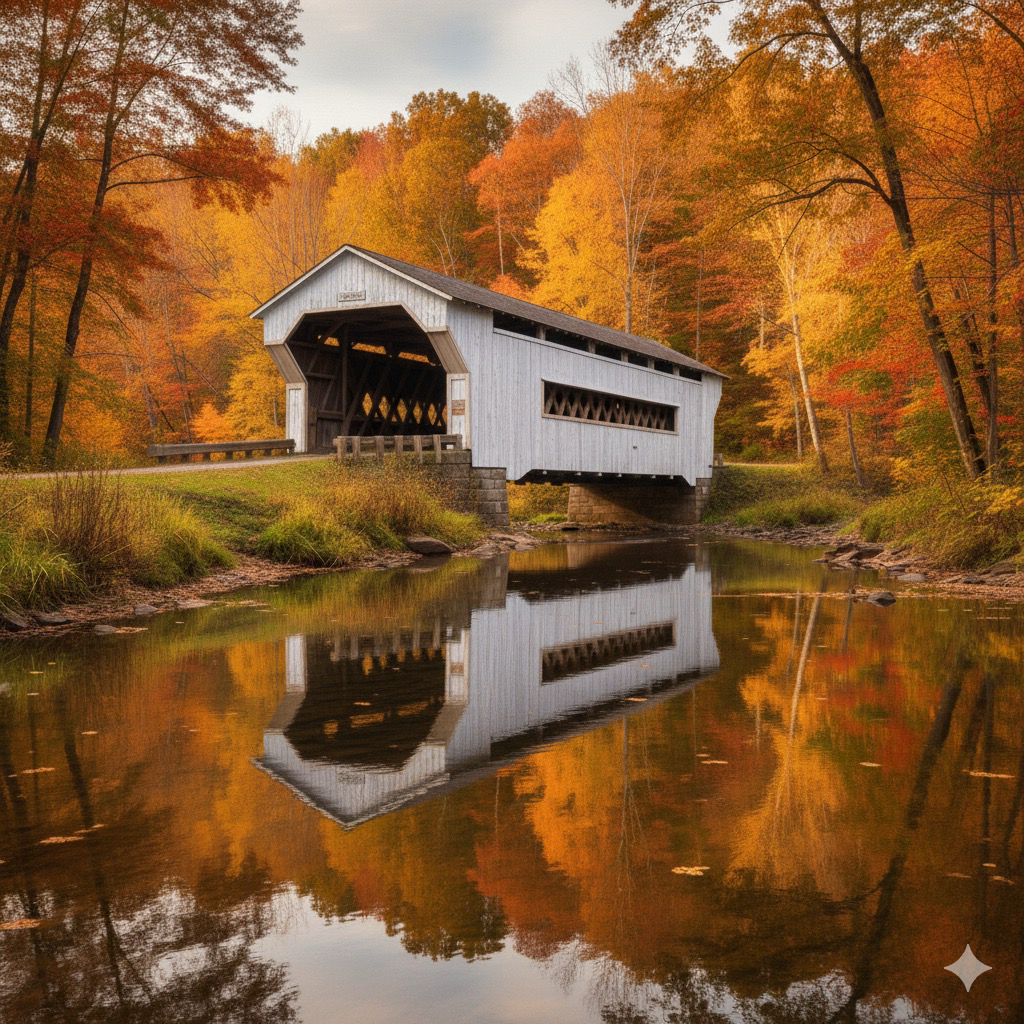
The Bridgeton Bridge is perhaps the most “memorable” in the county and serves as a powerful symbol of its modern identity. The original, a 245-foot, double-span Burr Arch masterpiece, was built in 1868 by the legendary J.J. Daniels. It stood for 137 years as the scenic anchor of the village, paired with the 1870 Bridgeton Mill.
On April 28, 2005, the historic bridge was completely destroyed by an arsonist. This act was an existential threat to the community’s heritage and tourism economy. The response, however, defines Parke County’s commitment. The community did not erect a modern concrete replacement. Instead, residents and volunteers rallied to rebuild a near-exact replica of the 1868 Daniels bridge, which was completed in 2006. This $10,200 (original 1868 cost) bridge’s destruction and subsequent rebirth demonstrate that these structures are not passive relics but living landmarks, actively maintained and fiercely protected by the community. - The Mansfield Bridge (#5) and Roller Mill: The Economic Hub
The 247-foot, double-span Mansfield Bridge, built by J.J. Daniels in 1867, exemplifies the concept of symbiotic placemaking. Its identity is inextricably linked to the adjacent Mansfield Roller Mill, an 1875-era gristmill now operated as a state historic site. The mill, which still contains its original turbine machinery from 1886, provides a historical “critical mass” with the bridge. This authentic pairing creates the aesthetic and cultural anchor for one of the largest and most bustling festival hubs. During the 10-day festival, this village—which has fewer than 20 permanent residents—is transformed into a massive market for “hundreds of vendors,” and the bridge is closed to auto traffic to accommodate the crowds. The bridge and mill provide the “sense of place” that attracts the commerce, and the commerce, in turn, provides the economic incentive and funds to preserve the historic assets. - The West Union Bridge (#26): The Engineering Marvel
This structure is not just a local treasure; it is a national one. At 315 feet long (337 feet portal-to-portal), the West Union Bridge is the longest covered bridge in Parke County. Built in 1876 by J.J. Daniels to replace a previous bridge of his that was destroyed by a flood, it is a massive double-span Burr Arch Truss crossing Sugar Creek.
Its engineering and integrity are so significant that it is considered one of the “nation’s best-preserved examples of the Burr truss”. In recognition of its profound architectural importance, the bridge was elevated from its 1978 National Register of Historic Places listing to the far more exclusive status of National Historic Landmark in 2016. It represents the pinnacle of 19th-century timber engineering and is arguably the county’s single most important architectural asset. - The Portland Mills Bridge (#24): The Survivor
Built in 1856 by Henry Wolfe, the Portland Mills Bridge is the oldest surviving covered bridge in Parke County. Its history highlights the active, expensive, and ongoing nature of preservation. The bridge was not originally built in its current location; it was moved and relocated over Little Raccoon Creek in 1960.
More telling is its 1996 rehabilitation. A 1998 report details the extensive restoration, which cost $353,000 to repair rotted timbers and install a new roof. That same report explicitly notes that building a new, modern, two-lane concrete bridge at the site was estimated to cost $575,000. The county’s decision to spend $353,000 to save the historic, one-lane timber structure—rather than “upgrading” to a modern one—is definitive financial proof of a preservation-first policy. It demonstrates a clear, long-term commitment to heritage over modernization.
Planning a Comprehensive Visit: A Tourism and Logistics Analysis
A visit to Parke County is a logistical undertaking, as the 31 bridges are scattered across remote farmland and wooded ravines. The county has developed a highly effective system to manage this tourism.
The “Hub”: Parke County Visitors Center
The logical starting point for any visit is the Parke County Visitor’s Center. It is strategically located in the county seat of Rockville, inside the historic 1883 Train Depot. This center serves as the primary distribution point for the official Parke County Map, an essential tool for navigation. Visitors can download the map from the tourism website or request a printed copy be mailed to them.
Navigating the “Spokes”: The 5 Self-Guided Driving Routes
To solve the “where do I start?” problem, the county has organized its 31 bridges into five color-coded, self-guided driving tours. This system packages the rural backroads into manageable, themed itineraries, turning a potential logistical challenge into a curated adventure.
The routes are as follows:
* Red Route (34 miles): Praised as one of the “best” routes, passing through “colorful towns and bridges”.
* Black Route (33 miles): Also considered one of the “best” routes for its scenery.
* Brown Route (24 miles): The shortest route, notable for being entirely paved. It includes the Mecca and Phillips bridges.
* Blue Route (36 miles): A 36-mile mixed-surface route that includes 3 miles of gravel. It features the Jackson, Cox Ford, and Catlin bridges.
* Yellow Route (34 miles): This is the “expert level” route. It is described as the “least interesting,” “most remote,” and “most rugged,” with a significant amount of dirt and gravel roads.
Beyond the Bridges: The Ancillary Destination Pillars
Parke County has successfully cultivated a multi-layered destination appeal, ensuring that visitors drawn by the bridges are offered a complete, immersive experience. This diversification creates a more resilient, year-round tourism economy.
Pillar: Outdoor Adventure (Turkey Run and Shades State Parks)
Turkey Run and Shades are two of Indiana’s most visited and cherished state parks. They are a primary draw in their own right, famous for “rugged” hiking through deep sandstone gorges, canyons, and primeval hemlock groves. Sugar Creek, which flows through the park, is a hub for serene paddling, offering kayak, canoe, and tube rentals. This attraction is directly linked to the bridge heritage, as the historic Narrows Covered Bridge (#37) is located within Turkey Run State Park.
Pillar: Cultural Immersion (Amish Community and Small Towns)
The county is “sparsely populated” and “largely Amish,” offering visitors a genuine “step back in time”. Horse-drawn buggies are a common sight on the country roads. This cultural pillar is an authentic part of the county’s fabric and is accessible through a network of Amish-run businesses, including :
* Specialty Foods: Meadow Valley Farms (Amish cheese), Guion Hill (Amish pretzels and produce), and Sunset View Groceries.
* Groceries/Goods: Fisher’s Discount Store and Grocery, King Bee (beekeeping supplies), and Marshall Farm Supply.
3. Pillar: Unique and “Quirky” Tourism
Parke County has cultivated niche attractions that generate significant buzz.
* The Old Jail Inn: Perhaps the most unique lodging in the state. The former county lock-up, which was in use until 1998, has been transformed into a bed and breakfast where visitors can “sleep in the cells” and take selfies in prisoner uniforms. It also features the aptly named “Drunk Tank Wine” bar.
* The Sanatorium: The imposing, abandoned Indiana State Sanatorium is now a destination for paranormal tours, overnight ghost hunts, and historical exploration.
4. Pillar: A Year-Round Events Calendar
While the October festival is the main event, the county maintains a full calendar to attract visitors year-round. Key events include:
* Winter: The Bridgeton Country Christmas (held over multiple weekends in Nov/Dec) and the Eagles in Flight Weekend at Turkey Run State Park (Jan).
* Summer: The Rosedale Strawberry Festival (June) and the Miami Indian Gathering (June).
* Specialty: The “Dine on a Covered Bridge” series. These are exclusive, premium-priced, ticketed events, including a brunch at the Mecca Covered Bridge and a formal dinner at the Bridgeton Bridge. These events sell out far in advance (2025 events are sold out) and serve as a key fundraiser for the Parke County Incorporated Charitable Trust, which funds preservation efforts.
A Practical Directory: Lodging and Dining
Lodging: A Categorized Accommodation Analysis
The county offers a full spectrum of accommodations, from “primitive” camping to historic B&Bs.
* 1. Inns, Hotels, and Motels:
* In-Park: The Turkey Run Inn is a major destination, located directly inside the state park and offering traditional inn rooms, an indoor pool, and cabins.
* Rockville Motels: The county seat of Rockville provides several traditional motels, including the Royal Inn, Motel Forrest Rockville, Parke Bridge Motel, and Covered Bridge Motel.
* Regional Chains: Visitors seeking major hotel chains will find them in the nearby cities of Terre Haute, Crawfordsville, and Greencastle, which are home to brands like Best Western, Quality Inn, and Hampton Inn.
* 2. Bed & Breakfasts and Guesthouses:
* The Unique Stay: The Old Jail Inn in Rockville offers a one-of-a-kind experience.
* The Farm Stay: Granny’s Farm B&B in Marshall provides a country setting near Turkey Run State Park.
* Town Stays: Options include the Monarch B&B in Rockville and The Homestead B&B in Montezuma.
* 3. Cabins and Campgrounds:
* This is a primary option for visitors focused on outdoor recreation.
* Parks: Turkey Run State Park (cabins and campground), Raccoon Lake SRA (campgrounds), and Rockville Lake Park (cabins) are all popular choices.
* Private: Numerous private options exist, such as The Narrows Cabins and Sugar Valley Canoe Camp.
Dining: A Taste of Parke County
The county’s dining scene is defined by hearty Hoosier comfort food, with a clear distinction between festival fare and year-round establishments.
* 1. Festival Food: This is a major attraction in itself, summarized in the official “Festival Food Guide”. It is a “foodie’s paradise” focused on traditional, mouth-watering favorites like world-famous buried beef, hand-breaded tenderloins, steaming soup beans, and countless homemade pies.
* 2. Unique Dining Experiences:
* Dine on a Covered Bridge: The most exclusive dining ticket in the county. This series of ticketed meals (brunch on Mecca Bridge, formal dinner on Bridgeton Bridge) is a sought-after experience that directly funds the preservation of the bridges.
* 3. Year-Round Restaurants (Notable Selections):
* Traditional American / Bars: The Thirty Six Saloon – Hog Pit in Rockville is a popular stop, along with the historic Mecca Tavern and the Mansfield Village Bar and Grill.
* Diners and Breakfast: Staples for locals and tourists include Benjamins Family Restaurant, The Ranch Rockville, Aaron’s on the Square (all in Rockville), and the Main Street Diner in Rosedale.
* Wineries and Coffee: The Drunk Tank Winery at the Old Jail Inn and the Cross at a Walk Britton Winery offer local vintages. Coffeehouses and bakeries like the Bloom & Birdie Coffeehouse and the Lyford Donut Barn are popular stops.
* In-Park: The Narrows Restaurant at the Turkey Run Inn provides convenient dining for park visitors.
Concluding Analysis: The Future of a Heritage Destination
This analysis confirms that Parke County’s “Covered Bridge Capital of the World” title is a quantifiable identity, not a simple marketing slogan. It is an identity built on the solid historical-geographic anomaly of a 19th-century “Silicon Valley” of master bridge builders—Daniels, Britton, and Wolf—who saturated their home county with their work.
This identity has been successfully and strategically leveraged into the county’s “major industry” through two key pillars:
* A Keystone Event: The 10-day, 10-hub Covered Bridge Festival, which creates an immersive, county-wide economic pilgrimage.
* **Accessible Infrastructure: A user-friendly system of color-coded driving routes that package the “remote” backroads for mass tourism.
However, the Parke County model is inherently fragile. The county’s primary economic assets are 150-year-old timber structures vulnerable to fire, flood, vehicle damage, and simple neglect. The 2005 arson that destroyed the Bridgeton Bridge was an existential threat.
The community’s response to that fire—to rebuild the historic bridge from scratch in 2006 —is the single most important data point for the county’s future. It proves a collective will to actively maintain this identity, not just passively benefit from it. Parke County is not a static museum; it is an active, ongoing project in applied history. Its success hinges on a delicate, symbiotic loop: the 31 bridges must be preserved to attract the tourists, and the tourists must come to provide the economic incentive and the funds (via organizations like the Parke County Incorporated Charitable Trust) necessary for that preservation. The county’s future depends on its ability to protect its physical assets while simultaneously preserving the “authentic,” “rustic” brand that makes them a destination.
https://www.facebook.com/share/19izhdkPYU/?mibextid=wwXIfr

You must be logged in to post a comment.