
Disclaimer: This article provides an objective, analytical overview of the ongoing 2026 Middle East conflict based on available reporting and geopolitical assessments. The intent is strictly neutral reporting of the facts and strategic realities of the situation. The publication of this analysis does not constitute an endorsement, condonation of any military or political actions taken by the belligerent parties, nor does it take sides in this conflict.
Introduction: The Fog of Operation Epic Fury
The road to the current catastrophe was paved in June 2025 during the “Twelve-Day War,” an intensive precursor that saw Israeli and American forces dismantle Iranian nuclear sites and eliminate IRGC chief Hossein Salami. While that conflict ended in a fragile ceasefire, the strategic dam finally broke on February 28, 2026. Washington and Jerusalem launched “Operation Epic Fury,” an onslaught of nearly 900 precision strikes within a single 12-hour window. The objective was surgical: a “decapitation” strike intended to paralyze the regime by vaporizing its leadership. However, as of mid-July 2026, the American expectation of a quick, clean victory has evaporated into the reality of a grinding war of attrition. What was supposed to be a collapse has become a “Total War,” redrawing the map of the Middle East and pushing the global economy to the brink. To understand this crisis, we must look past the daily bombardment and identify the counter-intuitive takeaways defining a conflict that refuses to follow the Pentagon’s script.
Takeaway 1: The Myth of the “Decapitation Strike”
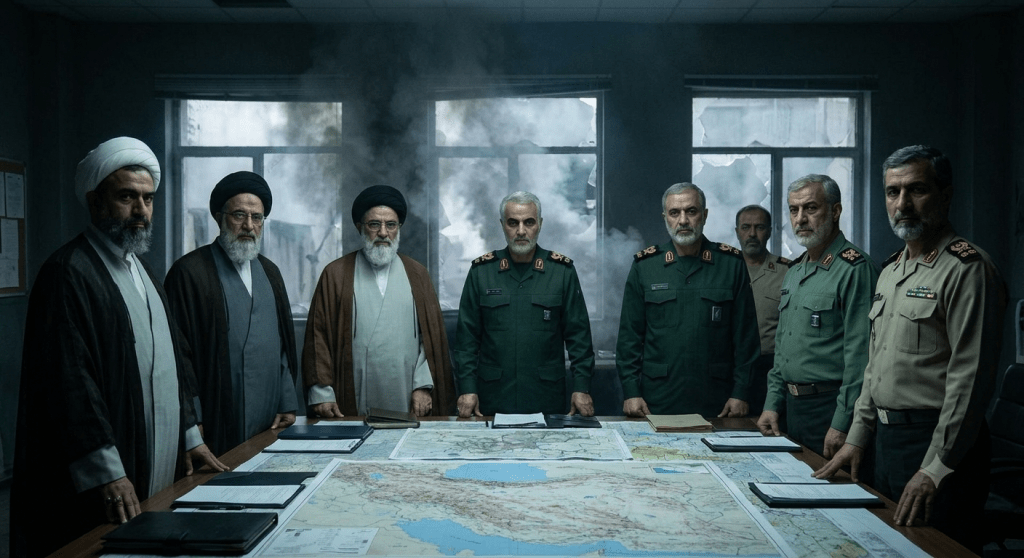
The centerpiece of Epic Fury was the destruction of Ayatollah Ali Khamenei’s Tehran compound, which killed the Supreme Leader alongside dozens of high-ranking clerics. US strategists bet the house on a “Theory of Decapitation,” assuming that removing the theocratic apex would trigger command paralysis and a popular uprising. It was a catastrophic miscalculation. Instead of fracturing, the Iranian state demonstrated a chilling institutional resilience. Power was consolidated almost instantly under a temporary leadership council before the Assembly of Experts appointed Mojtaba Khamenei, the late leader’s son, as the new Supreme Leader. Rather than inducing surrender, the assassination served as an ideological catalyst, allowing hardliners to frame the war as an existential struggle for national survival.
The operational theory underpinning the decapitation strike relied on the assumption that eliminating the absolute apex of the Iranian theocratic hierarchy would induce immediate command paralysis… However, geopolitical analysis of the aftermath reveals that the Iranian state possessed significant institutional resilience and robust continuity-of-government protocols.
Takeaway 2: When Water Becomes a Weapon (The Infrastructure Shift)
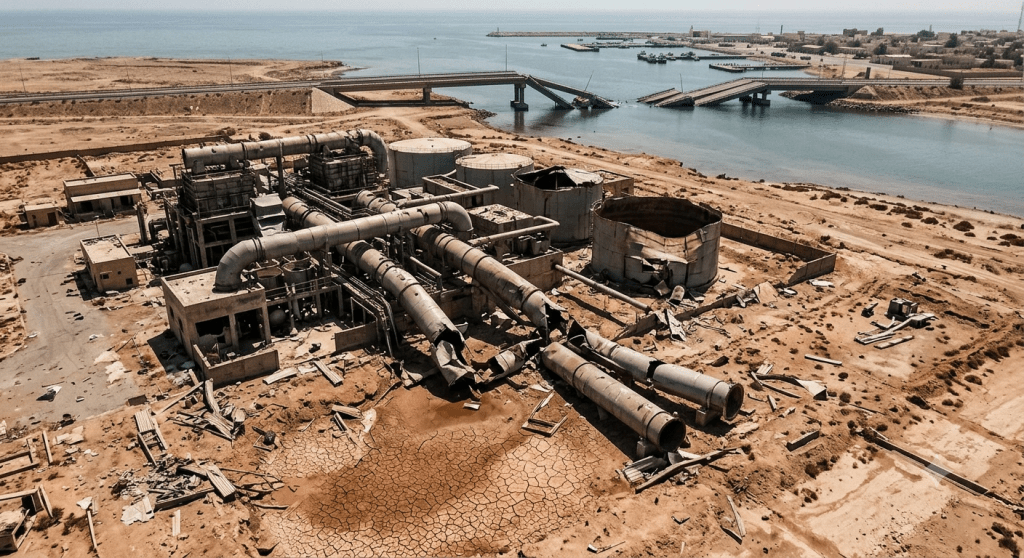
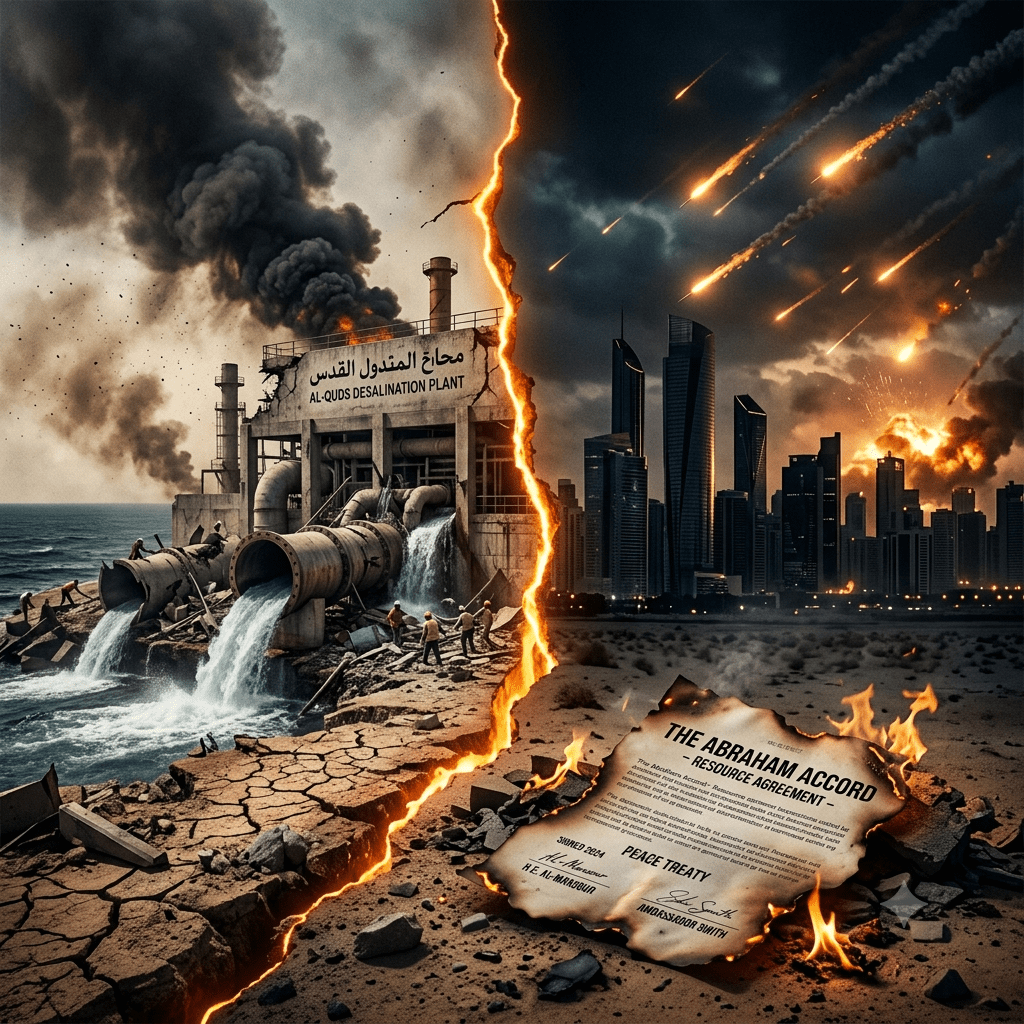
By July 2026, the conflict evolved from military-to-military engagement into a devastating campaign of infrastructure degradation designed to create “societal friction”. In response to an attack in Jordan that killed two American service members, the U.S. military launched a new wave of airstrikes. When the US launched its eighth consecutive night of strikes this month aimed to “swiftly punish” the Revolutionary Guard, the targets shifted from missile silos to the very foundations of civilian life. U.S. Central Command reported hitting surveillance sites, maritime capabilities, logistics infrastructure, and underground weapons storage. The human cost has been staggering. In the southern Hormozgan province, the state-run news agency IRNA reported the destruction of the Bonji desalination plant, instantly cutting off drinking water for 10,000 civilians. Even more lethal were the strikes on the Bandar Abbas highway, where the destruction of tunnels and bridges resulted in at least 50 deaths and over 500 injuries in a single night.
- Water Supply: The Bonji plant and facilities on Qeshm Island, leaving thousands without potable water in the summer heat.
- The Energy Grid: Systematic strikes on electricity generation nodes, forcing the Iranian Energy Ministry to implement emergency rationing.
- Logistics Arteries: Precision strikes on three critical bridges and two tunnels leading to Iran’s primary commercial port.
This “Total War” logic has already crossed borders, with Iranian drones retaliating against water and power facilities in Kuwait, forcing the Kuwaiti government to advise civilians to ration power.
Takeaway 3: The Strait of Hormuz is Now a Toll Road
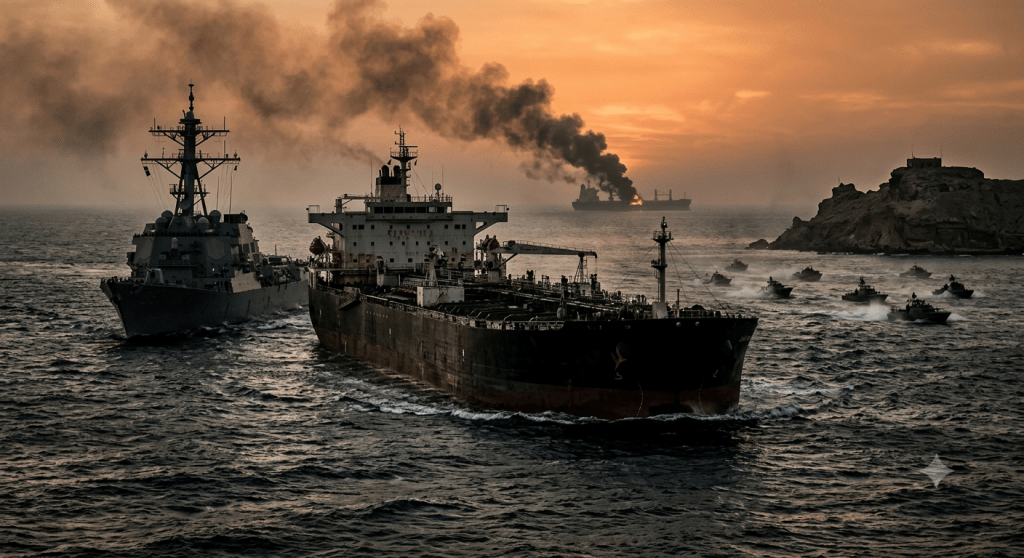
The Strait of Hormuz, the world’s most vital energy artery, has effectively been converted into a tactical “toll road”. Iran has leveraged its control over three “unsinkable aircraft carriers”—the islands of Abu Musa, Greater Tunb, and Lesser Tunb—to hold 20% of the world’s oil supply hostage. The response from the Trump administration has been characteristically transactional. The President initially proposed a 20% “Reimbursement Fee” for any cargo transiting the strait under US naval protection. While this specific tariff was later traded for broader concessions from GCC states, it signaled the end of the US as a “disinterested” regional guardian. As maritime insurance becomes untenable and crude oil prices surge toward $80 a barrel, the rhetoric has turned apocalyptic. Following strikes that killed three Indian mariners, President Trump warned on social media:
A whole civilization will die tonight, never to be brought back again,
if disruptions to global trade continue.
Takeaway 4: The Paradox of the “Goodwill” Release
The war reached a bloody peak in mid-July when an Iranian ballistic missile and drone attack—using the same Shahed-101 “Tower 22” blueprint that killed US troops in 2024—struck a base in Jordan. The attack killed two American service members and left another missing in action. Yet, in the shadow of this lethality, a bizarre diplomatic signal emerged: the release of Dena Karari. Karari, a California-based dual national and head of the Children of Mehr Foundation, had been held since 2024. Her sudden release, hailed by the White House as a “gesture of goodwill,” highlights a jarring “compartmentalization” of statecraft. Tehran is proving it can kill American soldiers in Jordan while simultaneously using hostage releases as a backchannel “off-ramp,” signaling to Washington that a deal for regime survival—and the eventual release of $300 billion in frozen assets—remains on the table.
Takeaway 5 – The “September Surge” and the Waiting Game
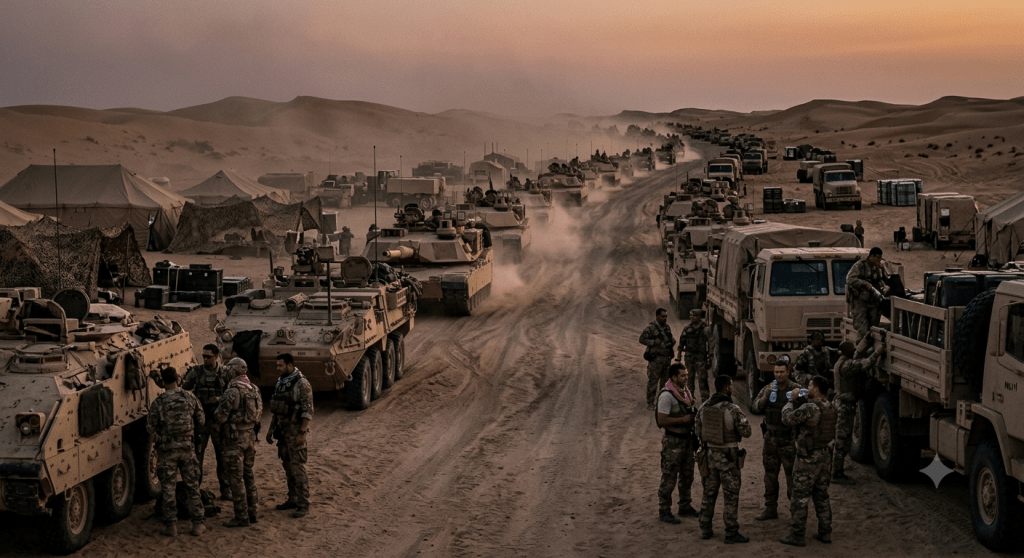
Despite the intensity of the air war, a ground invasion remains the “missing” piece of the conflict. Former Iranian deputy oil minister Asghar Ebrahimi-Asl has claimed that a massive buildup is underway in the UAE, alleging that the US is actively “recruiting foreign mercenary forces” to spearhead a land incursion. The delay appears to be a matter of thermodynamics, not politics. Strategists are reportedly waiting for the “cooler weather” of September to move ground forces into the punishing heat of the Iranian coast. The primary targets aren’t just cities, but economic organs:
- Kharg Island — The terminal for nearly all Iranian oil exports; seizing it would achieve total economic strangulation.
- Qeshm Island — A strategic hub for air defenses and the IRGC’s asymmetric naval “swarms.”
- Bandar Abbas — The logistical gateway that, if captured, would effectively sever the regime’s link to global trade.
Conclusion: No Exit in Sight
The collapse of the “Islamabad MoU” in early July 2026 marked the death of diplomacy. Signed in Versailles, France, the deal promised a $300 billion reconstruction fund and a 60-day ceasefire. Detailing the diplomatic collapse, Deputy Foreign Minister Kazem Gharibabadi told state TV that Tehran is suspending commitments to the interim deal and is “no longer implementing them.” It failed because the stakes were too high for everyone else: Prime Minister Netanyahu saw it as a strategic defeat for Israel, while the GCC states feared the reconstruction money would simply fund the next generation of IRGC proxy networks.
With the new Supreme Leader Mojtaba Khamenei warning of “unforgettable lessons” from the “Axis of Resistance” and declaring President Trump’s signature “worthless and invalid,” the region faces a protracted, highly destructive warfare that could last for years. The US is betting that infrastructure collapse will eventually do what the decapitation strike couldn’t: break the regime’s back. Iran is betting that $80 oil and the mounting toll of American casualties will break Washington’s political will first.
For a more in-depth, nuanced analysis, listen to the long-form deep dives below:
Apple Podcasts – https://podcasts.apple.com/us/podcast/the-chronos-archive/id1831231439?i=1000777388137
Created and Curated by Kenneth Henseler using Gemini Deep research and Gemini Notebook on Sun, Jul 19, 2026.
Sources Cited
Primary Source Document:
Additional References & Reports:
- Britannica: 2026 Iran war | Deal, Explained, United States, Israel, Strait of Hormuz, Map, & Conflict. Link [3]
- Wikipedia: 2026 Iran war. Link [3]
- Arab Center Washington DC: The US-Israel War on Iran: Analyses and Perspectives. Link [3]
- American Jewish Committee (AJC): The Iran Strikes, Explained: How We Got Here and What It Means. Link [3]
- AP News: What remains of the Iran deal as fighting rages. Link [3]
- PBS NewsHour: U.S. military launches new airstrikes to punish Iran for deaths of US troops. Link [3]
- CBS News: U.S. blockades Iranian ports, launches dozens of strikes as Trump seeks control of Strait of Hormuz. Link [3, 4]
- Bromsgrove Advertiser: US military launches new airstrikes to punish Iran for deaths of US troops. Link [4]
- Council on Foreign Relations: The Islamic Revolutionary Guard Corps (IRGC). Link [4]
- U.S. Department of State: Operation Epic Fury and International Law. Link [4]
- U.S. Central Command: Operation Epic Fury. Link [4]
- U.S. Department of War: Operation Epic Fury Spotlights. Link [4]
- TED Explains the World: The Attack on Iran — Why Now? (Ian Bremmer). Link [4, 5]
- American Jewish Committee (AJC): What is Iran’s Islamic Revolutionary Guard Corps and Why is it Designated a Terror Group. Link [5]
- Israel Defense Forces (IDF): Iran’s Proxies: Entrenching the Middle East. Link [5]
- National Counterterrorism Center: Islamic Revolutionary Guard Corps (IRGC). Link [5]
- Stimson Center: What is the US Doing in a Disputed Triangle on the Jordan/Syria/Iraq Border? Link [5]
- Wikipedia: Tower 22 drone attack. Link [5]
- U.S. Department of War: 3 U.S. Service Members Killed, Others Injured in Jordan Following Drone Attack. Link [5, 6]
- ABS-CBN: US launches new airstrikes to ‘punish’ Iran after two troops killed. Link [6]
- Iran International: Live – US begins eighth night of Iran strikes after Trump mourns troop deaths. Link [6]
- AP News: Why it’s so difficult for the US to fully reopen the Strait of Hormuz. Link [6]
- PBS NewsHour: 3 islands help control access to the Strait of Hormuz. They’re in the crosshairs of the Iran war. Link [6]
- AP News: US strikes hit northern Iran as it disables ship. Link [7]
- Fox News: US resumes blockade on Iran, launches strikes after attacks in Strait of Hormuz. Link [7]
- Arab Center Washington DC: The US-Iran Interim Deal: A Fragile Ceasefire. Link [7]
- The Guardian: US hits civilian infrastructure as it expands strikes against Iran. Link [7]
- Council on Foreign Relations: Iran’s War With Israel and the United States | Global Conflict Tracker. Link [7]
- ECIKS: U.S. citizen held in Iran since December 2024 departs country after Trump intervention. Link [7]
- CBS News: U.S. citizen departs Iran after being barred from leaving for over a year. Link [7, 8]
- The Washington Post: Iran releases U.S. citizen in goodwill gesture, Trump says. Link [8]
- The Indian Express: Amid tensions, Trump praises Iran for releasing US citizen in detention since 2024. Link [8]
- Crypto Briefing: Iran releases US citizen Dena Karari after nearly a year in custody. Link [8]
- Iran International: US waiting for cooler weather to launch ground incursion, ex-official says. Link [8]

You must be logged in to post a comment.