
Step past the wooded entry path at Clayshire Castle in Bowling Green, Indiana, and everything is tuned to pull you out of the 21st century. You smell roasting turkey legs in the late-September air, hear the rhythmic clang of a blacksmith's hammer, watch ribbons braid around a maypole, and weave past booths in a Wars of the Roses marketplace.
On Saturday, September 26, 2026, I stepped into one of those vendor tents—run by ConneRock (@connerock out of North Terre Haute, Indiana)—and asked the simplest question a geological skeptic can ask at a table full of tumbled stones:
"What's the oldest thing you've got?"
The vendor reached for a polished slab roughly five inches tall and an inch thick. Its top edge was rough, natural, and unworked, while the flat face flashed tight, wavy, alternating bands like an ancient geological barcode: heavy metallic steel-grey, deep oxblood red, and silky golden seams broken by occasional greenish-gold lenses.
The pitch was memorable: 2 to 2.5 billion years old, cut from a boulder brought back from a mountain in Madagascar. I handed over two twenties ($40, which hit my Apple Card as $42.80 with Indiana's 7% sales tax), shook hands, and brought the rock home.
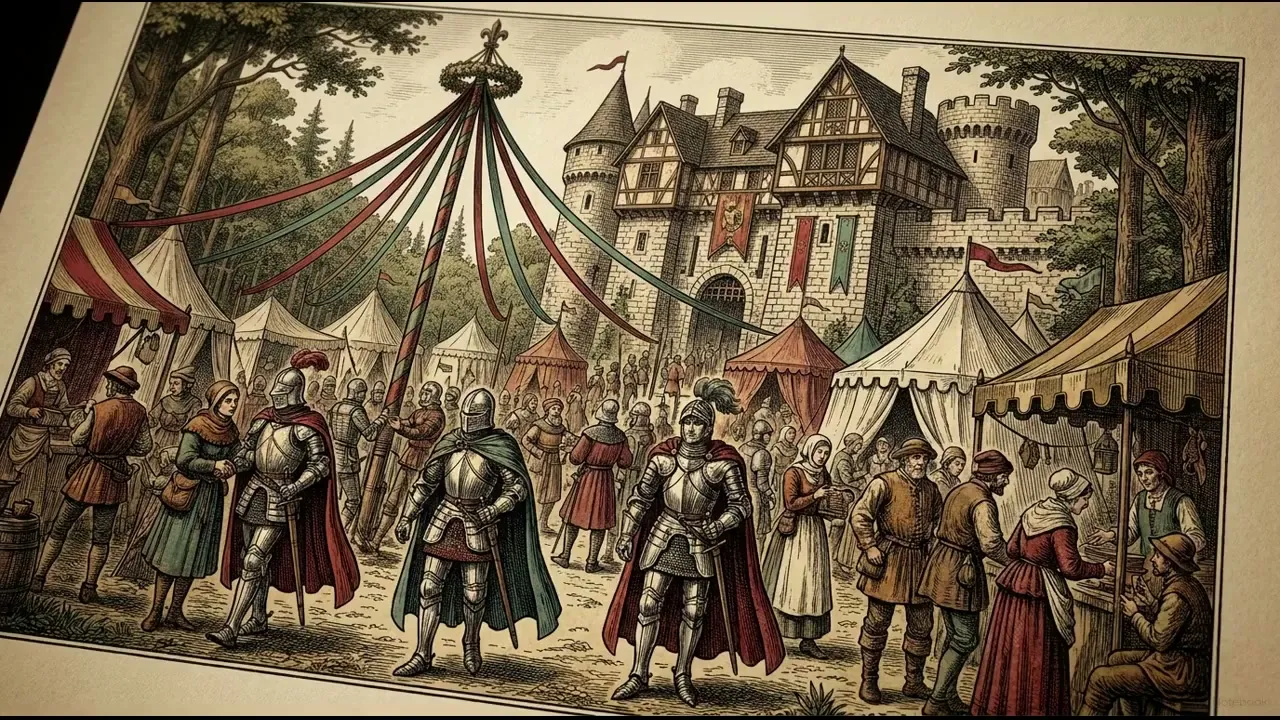
Clayshire Castle Medieval Faire in Bowling Green, Indiana (September 26, 2026), where an afternoon browse in a rock tent kicked off a four-part geological investigation.
Opening an Incident Ticket on a Souvenir
When someone hands an infrastructure engineer a $40 rock accompanied by a multibillion-year provenance story, the rock does not go straight onto a bookshelf. It gets treated like an undocumented production claim: break the pitch into independent variables, inspect the failure modes, and verify every claim against primary evidence.
That boiled the faire vendor's story down to four testable claims:
| Claim | Vendor Pitch | Verification Verdict | Primary Evidence |
|---|---|---|---|
| 1. Identity | Unlabeled "oldest rock" | Confirmed: Tiger Iron (mugglestone) |
Hematite + red jasper + chatoyant tiger's eye & greenish-gold hawk's eye |
| 2. Integrity | Natural slab for $40 | Almost certainly natural; fair price | Zero magnet pull, continuous depositional laminations, $25–$75 market band |
| 3. Age | 2 to 2.5 billion years old | Confirmed — and likely conservative | Archean/Paleoproterozoic BIFs dated ~2.46–3.02 Ga via U-Pb zircons |
| 4. Provenance | "Mountain in Madagascar" | Incorrect -> Traced to Western Australia | Malagasy BIFs are high-grade magnetite quartzites; ConneRock's supplier is Australian Outback Mining (Wundowie, WA) |
Notice right away how deceptive single-axis skepticism would have been here. A cynic who stopped at "Madagascar doesn't export tiger iron" would throw out the baby with the bathwater, assuming a synthetic trinket. Conversely, someone who stopped at verifying the mineralogy would repeat an inaccurate origin label. Auditing each claim independently separates what drifted upstream from what is stubbornly, physically real.
Claim 1: Identity — Three Minerals and a Refuted Textbook Story
Matching the slab's macro-pattern against Mindat's mineral database quickly identifies the rock as tiger iron—occasionally traded under the playful retail nickname mugglestone (a label sometimes linked in lapidary folklore to Mucklestone in Staffordshire, UK, though Staffordshire's ironstones lack this layered Archean assemblage).
Petrographically, tiger iron is a folded jaspilite—a variety of Banded Iron Formation (BIF) built from three distinct layers packed side by side:
- Steel-grey specular hematite (Fe₂O₃): Dense metallic iron oxide giving the slab its surprising heft and a silver-blue metallic sheen across the back face under direct light.
- Oxblood-red jasper / microcrystalline chert (SiO₂): Fine-grained silica stained crimson by disseminated hematite particles, sitting around 6.5–7 on the Mohs hardness scale.
- Golden chatoyant tiger's eye & greenish-gold hawk's eye lenses: Parallel fibrous quartz seams shimmering with a gliding band of light—an optical effect called chatoyancy. Mixed in among the warm golden seams are pockets of greenish-gold hawk's eye, where trace original blue-grey crocidolite / riebeckite amphibole iron remained less completely oxidized rather than turning wholly rust-gold. Unlike isolated cubic grains of pyrite ("fool's gold"), which flash with an isotropic brassy reflection, these fibrous lenses move light cleanly perpendicular to the fiber axis as you tilt the slab.
There is also a subtle twist in how those golden seams grew. Generations of gemology textbooks described tiger's eye as a slow, static pseudomorph: groundwater supposedly dissolved asbestos fibers (crocidolite) molecule by molecule and cast quartz inside empty microscopic molds. In 2003, Penn State crystallographers Peter J. Heaney and Donald M. Fisher examined thin sections under optical and scanning electron microscopes and showed that static replacement fails mechanically. Instead, tiger's eye forms via synchronous "crack-seal" vein growth during tectonic deformation—microscopic fractures crack open repeatedly under crustal stress while dissolved silica and trace blue riebeckite/crocidolite fibers grow together in step. What looks like magic under a lamp is billions of aligned microscopic crystals sealed inside solid quartz, completely safe to handle.
Claim 2: Integrity — Economic Threat Modeling and Bench Diagnostics
Whenever a geological specimen changes hands under a festival tent, a realistic threat model must check two possibilities: total forgery (cast resin, painted glass, sintered powder) or post-extraction cosmetic tampering (acid dyes, heavy heat treatments, excessive resin stabilization).
Start with the economics. Bulk rough tiger iron is sufficiently abundant in Western Australian deposits that trying to synthesize an interlocking composite of folded hematite, microcrystalline red jasper, and crack-seal fibrous quartz from scratch would cost far more than a $40 retail sticker. Checking specialist retail catalogs—including GemStoneGeeks, an Australian-sourced lapidary storefront—places palm-sized polished slabs of genuine Western Australian tiger iron squarely in the $25 to $75 range. Paying $40 ($42.80 with tax) means the buyer got normal specialty retail value with zero markup for the fairground lore.
To test physical integrity at the bench, we distinguish completed observations from follow-up checks still waiting on unglazed tile and a hydrostatic scale:
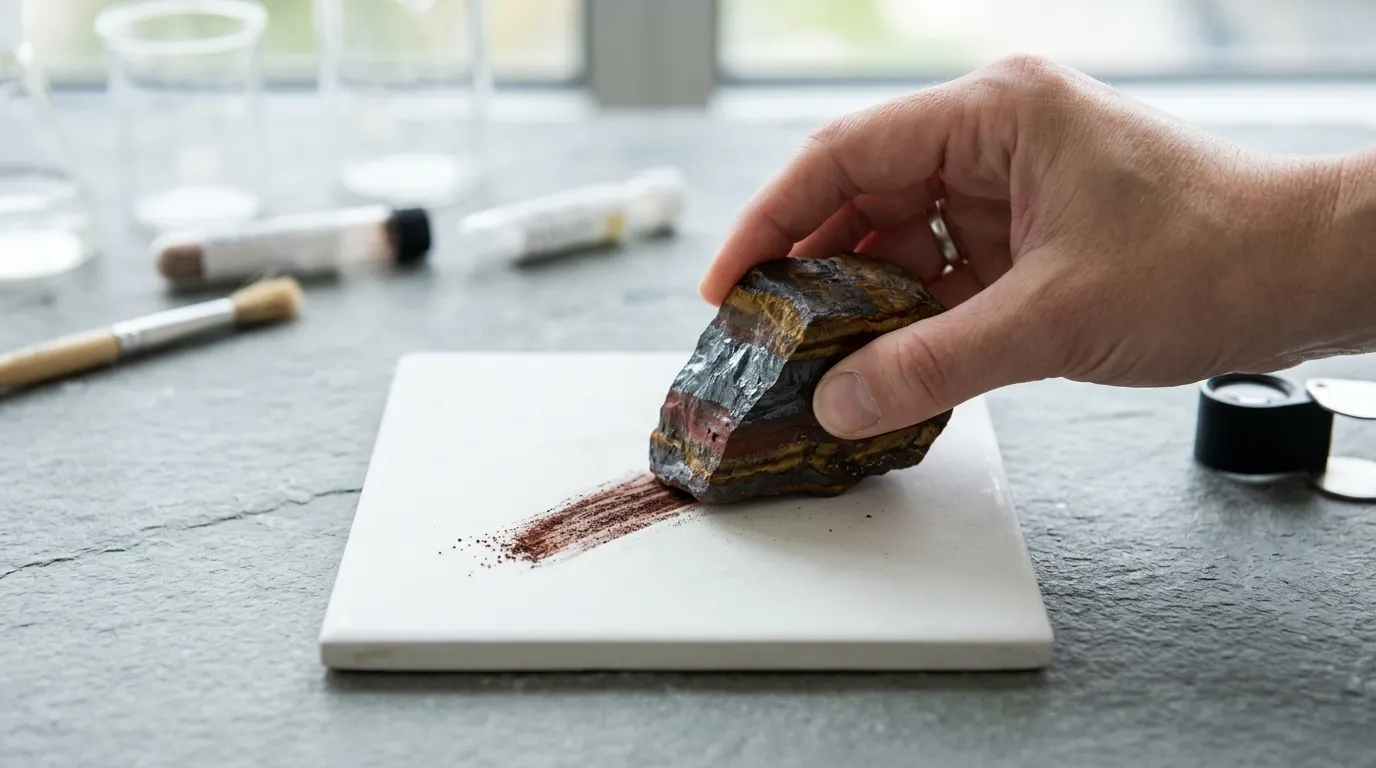
Porcelain streak diagnostics: genuine specular hematite appears steel-grey on a polished face yet powders to an unmistakable cherry-red or reddish-brown streak on unglazed tile.
| Bench Check | Current Status | Observation / Expected Signature | What It Rules Out |
|---|---|---|---|
| Weak & Strong Magnet Test | Completed | Zero snap or noticeable attraction across all steel-grey bands | Sintered barium/strontium ferrite imitations sold as "magnetic hematite," plus strongly ferromagnetic high-magnetite rocks |
| Edge Lamination & Fracture Audit | Completed | Rough unpolished crown reveals continuous sedimentary micro-layers and natural cross-fractures | Surface-printed graphics, cast resin pours, and glass-bubble slag |
| Point-Light Chatoyancy Sweep | Completed | Smooth directional light band glides across golden tiger's eye and greenish hawk's eye | Flat metallic sulfates or brassy pyrite flecks |
| Unglazed Porcelain Streak | Pending follow-up | Scraping the rough top corner should yield a vivid red-brown powder streak | Magnetite (black streak) or coated alloys |
| Specific Gravity & Mohs Scratch | Pending follow-up | Composite density spanning ~2.66 (quartz) to ~5.26–5.5 (hematite); quartz/jasper should scratch Mohs 5.5 glass | Low-density dyed polymers (<2.5) |
| Acetone Swab | Pending follow-up | Clean cotton swab along vibrant seams | Dyed quartz or oil-tinted imitations |
Notice why the magnet test immediately separates honest rocks from the most common gift-shop fake. Pure hematite (Fe₂O₃) is only weakly magnetic—you never see a refrigerator magnet snap onto a genuine hematite band. Gift-shop tumbled "magnetic hematite" beads are almost always synthetic barium or strontium ferrite ceramics pressed from dark powder, which snap aggressively onto magnets and leave dark-grey or black streaks rather than rusty red. Passing the non-magnetic check alongside continuous edge bedding already narrows the field sharply toward authentic natural BIF.
Claim 3: Deep Time — The Oceans That Rusted in Oscillations
Even if the stone is natural tiger iron, "2 to 2.5 billion years old" sounds like the kind of round number vendors invent to move tabletop inventory. In fact, it turned out to be the most conservative part of the pitch.
Banded Iron Formations are an essentially extinct sedimentary rock type. Earth today cannot build marine BIFs on this scale because modern oceans contain dissolved oxygen, which strips dissolved iron out of seawater near hydrothermal sources before it can spread across continental shelves.
During the Archean Eon, prior to ~2.45 billion years ago (Ga), Earth operated as an alien chemical reactor:
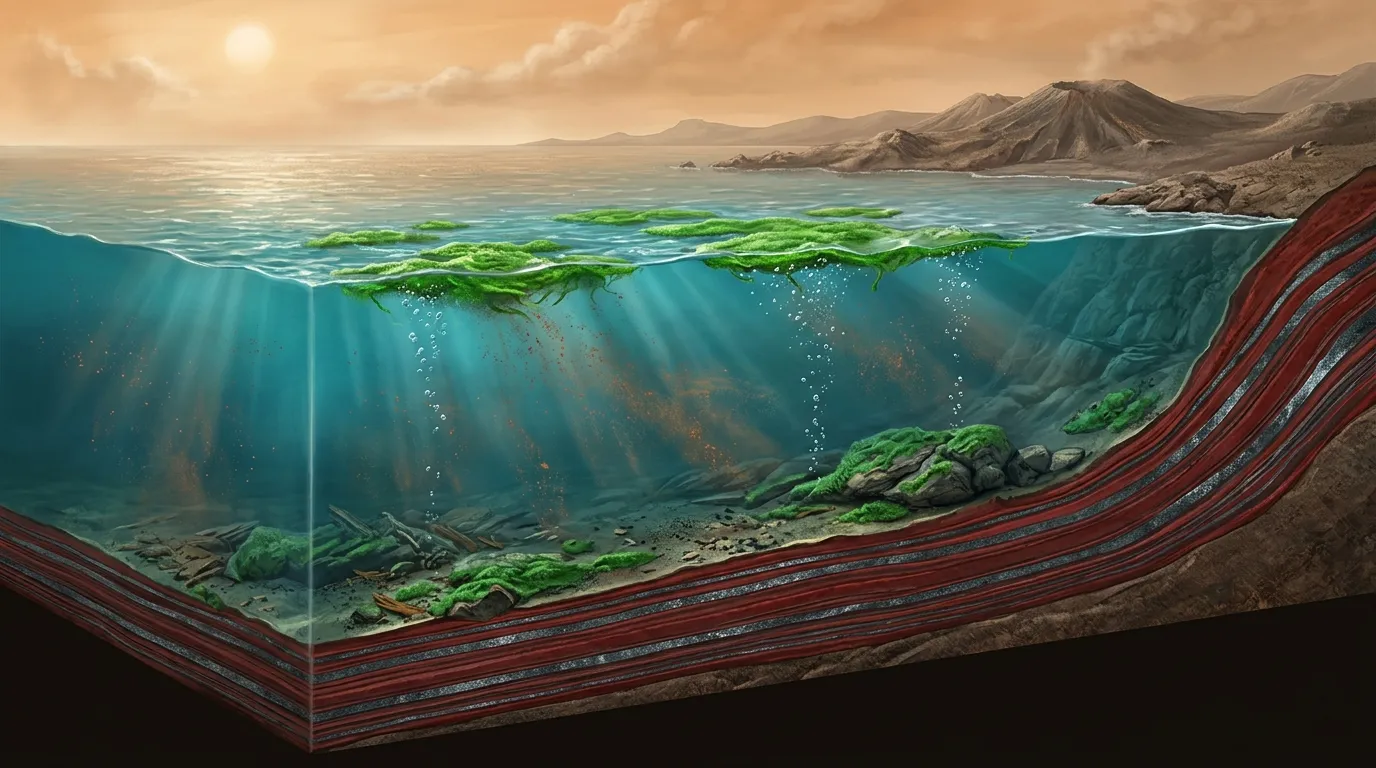
Before the atmosphere turned permanently oxygen-rich, photosynthetic cyanobacteria in shallow marine waters triggered localized rust precipitation over anoxic oceans loaded with dissolved ferrous iron.
- Submarine volcanism and hydrothermal vents pumped oceans full of soluble ferrous iron (
Fe²⁺) and dissolved silica (SiO₂). - Early marine cyanobacteria evolved oxygenic photosynthesis, splitting water molecules and releasing free oxygen (
O₂) as metabolic waste into an iron-saturated sea. - Free oxygen oxidized soluble
Fe²⁺into insoluble ferric iron (Fe³⁺) minerals, precipitating clouds of microscopic iron oxide rust onto the seabed whenever biological oxygen production pulsed—alternating rhythmically with red silica/jasper oozes during anoxic intervals.
For decades, geology textbooks summarized that transition as a relatively smooth one-way ramp into the Great Oxidation Event (GOE, ~2.45–2.22 Ga). In April 2025, a research team led by Xueqi Liang, Eva E. Stüeken, Daniel S. Alessi, Kurt O. Konhauser, and Long Li in Nature Geoscience shattered that linear picture using nitrogen isotope (δ¹⁵N) records preserved inside Western Australia's Hamersley Basin. Because marine bacteria fractionate light Nitrogen-14 faster than heavier Nitrogen-15 during low-oxygen denitrification cycles, δ¹⁵N trapped in ancient iron formations acts as a durable chemical proxy for how much free oxygen sat in seawater billions of years earlier.
Across a ~380-million-year window from 2.83 to 2.45 Ga, Liang et al. documented a ~200-million-year oscillation of oceanic oxygenation before the GOE permanently locked oxygen into Earth's air:
- ~3.02 Ga — Cleaverville Formation / Ord Ranges (Pilbara Craton, Western Australia): Mesoarchean seabed BIFs predating sustained atmospheric oxygenation—highlighted in Mindat's Ord Ranges galleries as one of the world's signature commercial tiger iron sources.
- 2.63–2.60 Ga — Marra Mamba Iron Formation (Hamersley Basin, Western Australia): Early Neoarchean oxygen surge documented across shelf BIFs and associated shales—notably another core host unit for commercial tiger iron.
- ~2.48 Ga — Dales Gorge Member (Brockman Iron Formation, Western Australia): Sharp positive
δ¹⁵Nexcursion recording a major marine oxygen deficit and widespread bacterial denitrification—an anoxic setback lasting tens of millions of years. - ~2.46 Ga — Brockman Iron Formation (Western Australia) & Kuruman Iron Formation (Northern Cape, South Africa): Zircon U-Pb tuff dating brackets both giant Paleoproterozoic iron basins right alongside South African crocidolite/tiger's eye terrains.
- 2.46–2.45 Ga — Joffre & Weeli Wolli Formations (Hamersley Group, Western Australia): Renewed seawater oxygenation carrying straight into the 2.45–2.22 Ga Great Oxidation Event, when Earth's dissolved-iron ocean buffer finally exhausted itself and free
O₂escaped permanently into the sky.
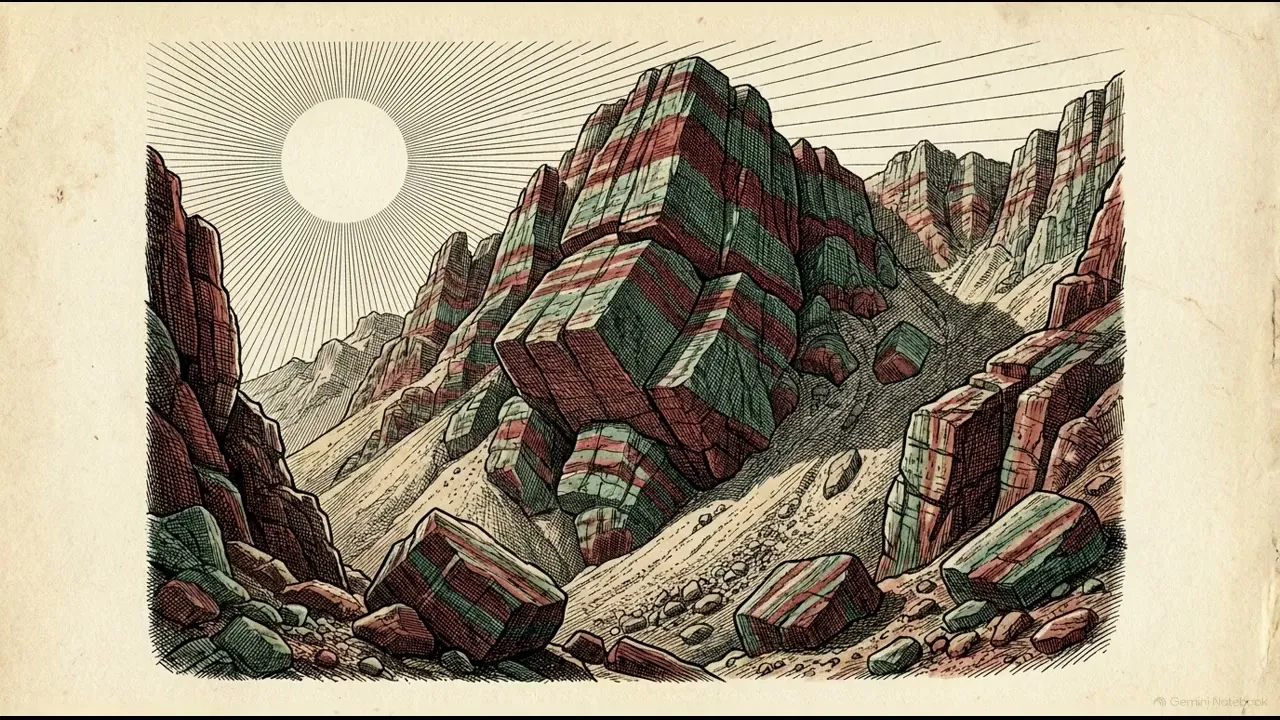
Exposed Banded Iron Formation strata in Western Australia's Pilbara craton—hundreds of meters thick across the Hamersley Basin, encoding billion-year-old shifts between iron-rich seas and photosynthetic oxygen pulses.
Notice what that chronostratigraphy means for Claim 3: whether that five-inch slab was quarried from the Marra Mamba / Brockman beds (~2.63–2.46 Ga) or the Ord Ranges / Cleaverville unit (~3.02 Ga), the vendor did not exaggerate. If it came from Ord Ranges crust, he undersold its age by half a billion years.
Claim 4: Provenance — Why "Madagascar" Broke Down, and the October 15 Closure
Three out of four claims held up remarkably well. The geographic origin—"a mountain in Madagascar"—was the single point where the ticket stayed red.
To be fair to the pitch, Madagascar is not geologically empty. Precambrian iron formations roughly 2.2 to 2.5 billion years old do exist in northwestern Madagascar—most notably the Soalala iron ore province. The mismatch lies in what plate tectonics did to them afterward. During the assembly of Gondwana, Madagascar's ancient sediments were buried deep inside collisional mountain belts and baked under high-grade metamorphism, recrystallizing into coarse magnetite-rich quartzites rather than delicate low-grade jaspilite preserving millimeter-scale jasper and fibrous golden crack-seal quartz.
Both primary catalogs confirm the gap:
- Mindat documents verified tiger iron localities in Western Australia and lists zero commercial localities in Madagascar.
- The U.S. Geological Survey Minerals Yearbook for Madagascar (2019) inventories Malagasy industrial minerals and gemstones (sapphire, ruby, tourmaline, emerald, quartz, iron ore projects at Soalala) without a single entry for tiger iron or tiger's eye.
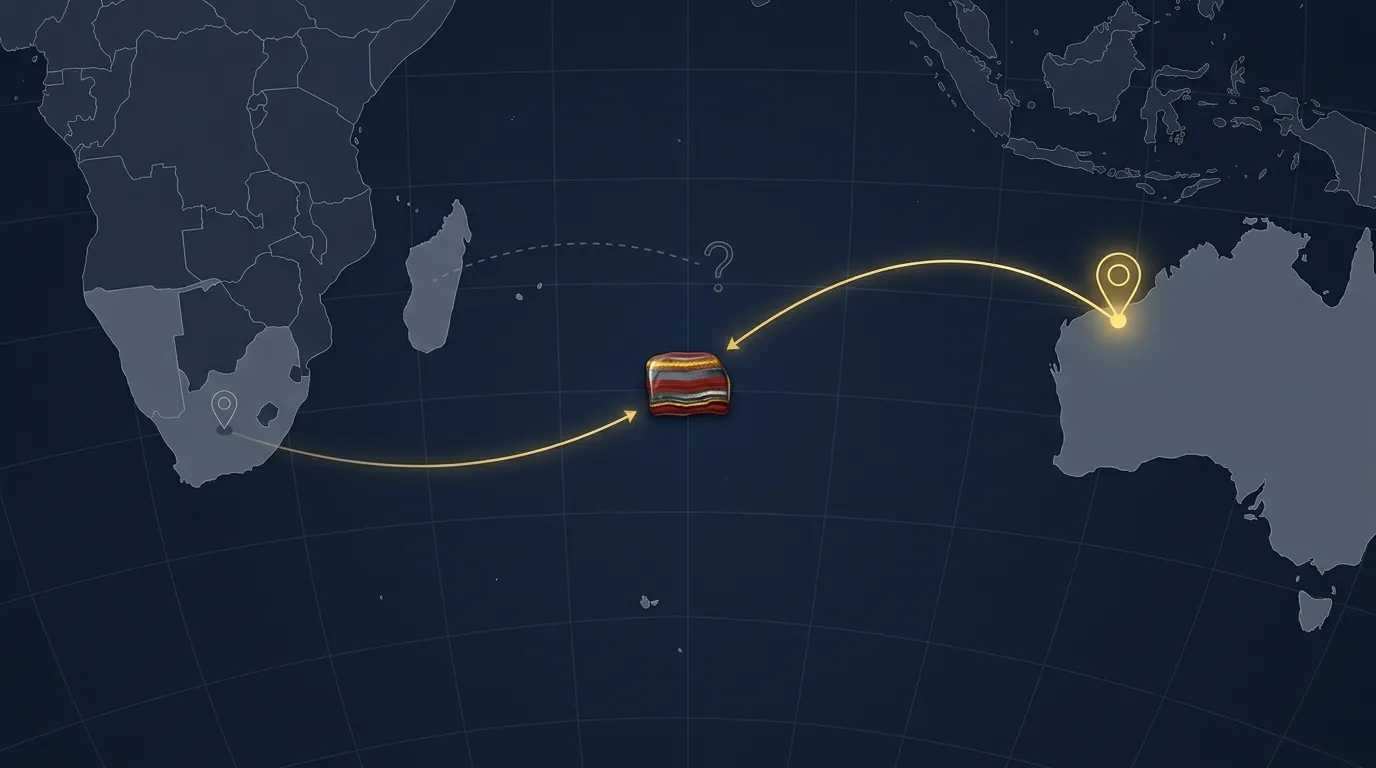
Supply-chain telemetry versus mineral reality: Western Australia's Pilbara Craton dominates global tiger iron output, while Malagasy Precambrian deposits underwent intense high-grade metamorphism into magnetite quartzites.
So why did a friendly Indiana vendor at Clayshire Castle say Madagascar? Rather than accusing anyone of fabricating a tale—everything about the specimen, pricing ($40), and openness pointed toward good faith—the likeliest culprit was upstream supply-chain drift: a crate loses its tag in a regional wholesale warehouse, someone associates colorful cut slabs with Madagascar's booming gem exports, and the label sticks down three links of retail resellers.
Two weeks later, I got a chance to test that hypothesis in person.
On Thursday, October 15, 2026, I visited the Parke County Covered Bridge Festival in Bridgeton, Indiana (running October 9–18, 2026, 9 a.m. to 5 p.m. daily), walked back up to ConneRock's booth, and asked where the big cut tiger iron boulder originally came from upstream.
Without hesitation, ConneRock named the wholesale supplier: Australian Outback Mining, run by Glenn.
Public mining and retail records trace Glenn Archer directly to Australian Outback Mining near Wundowie, Western Australia—just east of Perth—who also operates the specialist retail storefront GemStoneGeeks. That single connection closed the loop in full: GemStoneGeeks was literally the Australian storefront whose $25–$75 tiger iron slab listings had calibrated our Claim 2 fair-price benchmark weeks earlier. The rock was almost certainly mined in Western Australia, passed cleanly through legitimate commercial channels into Indiana, and only picked up the "Madagascar" gloss somewhere along the wholesale retelling.
Honest Audit: What Still Remains Unconfirmed
Closing the vendor provenance loop still leaves two factual boundaries worth stating plainly:
- Exact Western Australian Quarry: Tracing ConneRock's supplier to Australian Outback Mining (
Wundowie, WA) confirms Western Australian sourcing, but wholesale/retail listings do not stamp an exact pit or formation onto every five-inch display slab. Without thin-section geochemistry or U-Pb zircon dating, whether this exact slab came from the ~3.02 Ga Ord Ranges / Cleaverville Formation or the ~2.63–2.46 Ga Hamersley Basin (Marra Mamba/Brockman) remains unconfirmed. - Pending Physical Bench Follow-Ups: Magnetic non-attraction, edge depositional bedding, stress cross-fractures, and directional chatoyancy are verified. Dragging the unworked top edge across unglazed white porcelain for a red-brown hematite streak, measuring hydrostatic specific gravity (
~2.66–5.5), and checking seams with an acetone swab remain open follow-up checks.
All told, two twenty-dollar bills at a medieval faire bought a genuine chemical fossil of Earth learning to breathe—and showed how closing an incident ticket in person beats cynicism every time.
Episode & Sources
Primary Sources & Peer-Reviewed Literature Cited
- Mindat — Tiger Iron (Variety #10886): Mineralogical composition (
hematite,jasper,tiger's eye) and Western Australian locality catalog — mindat.org/min-10886.html - Mindat — Ord Ranges Tiger Iron Gallery (Pilbara Craton, WA): Mesoarchean (~3.02 Ga) Cleaverville-area tiger iron specimen provenance — mindat.org/gl/245203
- Western Australian Museum — Banded Iron Formation Collection: Geological overview of dissolved-iron Archean oceans and Great Oxidation Event rust precipitation — museum.wa.gov.au
- Liang, X., Stüeken, E. E., Alessi, D. S., Konhauser, K. O., & Li, L. (2025): "A seawater oxygen oscillation recorded by iron formations prior to the Great Oxidation Event," Nature Geoscience — nature.com/articles/s41561-025-01683-7
- U.S. Geological Survey (2019): Minerals Yearbook: Madagascar (confirming Soalala iron ore projects and zero tiger iron production) — pubs.usgs.gov/myb/vol3/2019/myb3-2019-madagascar.pdf
- Heaney, P. J., & Fisher, D. M. (2003): Synchronous crack-seal vein growth mechanism in tiger's eye, reported via Science News — sciencenews.org/article/eye-tiger
- Clayshire Castle Medieval Faire (2026): Official marketplace vendor directory confirming ConneRock in Bowling Green, Indiana (Sept 26–27, 2026) — clayshirecastle.com/medieval-faire.html
- Parke County Covered Bridge Festival (2026): Official schedule (October 9–18, 2026, 9 a.m.–5 p.m.) — coveredbridges.com/covered-bridge-festival
- Australian Outback Mining / Glenn Archer (Wundowie, WA): Primary wholesale mining company named Oct 15, 2026 — outbackmining.com
- GemStoneGeeks — About Australian Outback Mining: Sister storefront documenting Western Australian tiger iron pricing ($25–$75) — sales.gemstonegeeks.com/pages/about-australian-outback-mining