
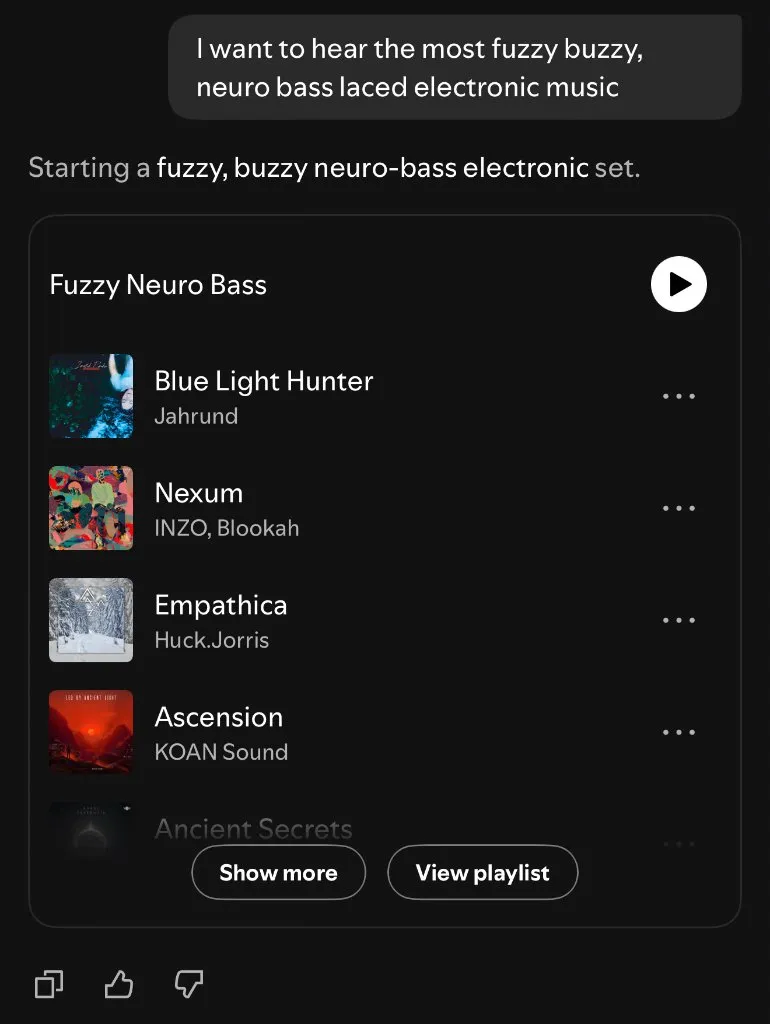
This started as a 2 a.m. prompt experiment: asking Spotify AI for "the most fuzzy buzzy, neuro bass laced electronic music." Spiritual cousin to FebruFuzzz and Mid Summer Static, pushed deeper into sub-bass territory.
To Spotify AI's credit, it skipped the obvious trap. Instead of dumping 30 tracks of relentless 174 BPM mainroom neurofunk, it built a surprisingly cohesive 30-track draft that got roughly 85% of the aesthetic right: psychedelic halftime, organic downtempo experimental bass, and murky UK 140 orbiting the worlds of KOAN Sound, Chmura, CloZee, Saturna, The Widdler, Mystic State, Mindex, Ferrofluid, and Swomp.
Here is the catch with vector-similarity playlists: 85% is right where algorithms stop. Turning a good pile of tracks into a playlist you actually want to press play on from Track 1 to the final reverb tail means auditing what broke the spell and sequencing the energy like a real set. Even better: I happened to be away from my desktop until Friday night, so the entire audit, cover-art build, live Spotify deployment, cross-platform sync, and this blog post became a real-world stress test of Google Antigravity running its newly launched Orchestrator (Neon) model—driven completely from a PWA on my iPhone.
The Full Phone-Only Workflow: Spotify AI → Antigravity (Neon) → Multi-Platform
What started as casual late-night listening turned into a clean four-stage pipeline—no laptop screen, no manual track-dragging, and zero plaintext credentials left on disk.
1. The Spark & JSON Handoff
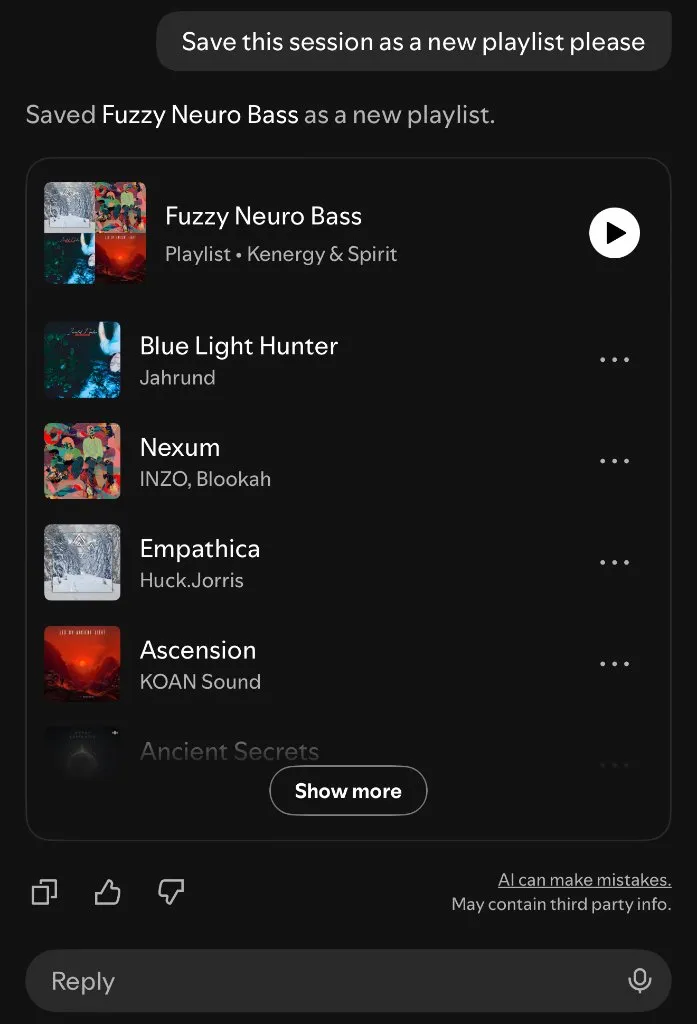
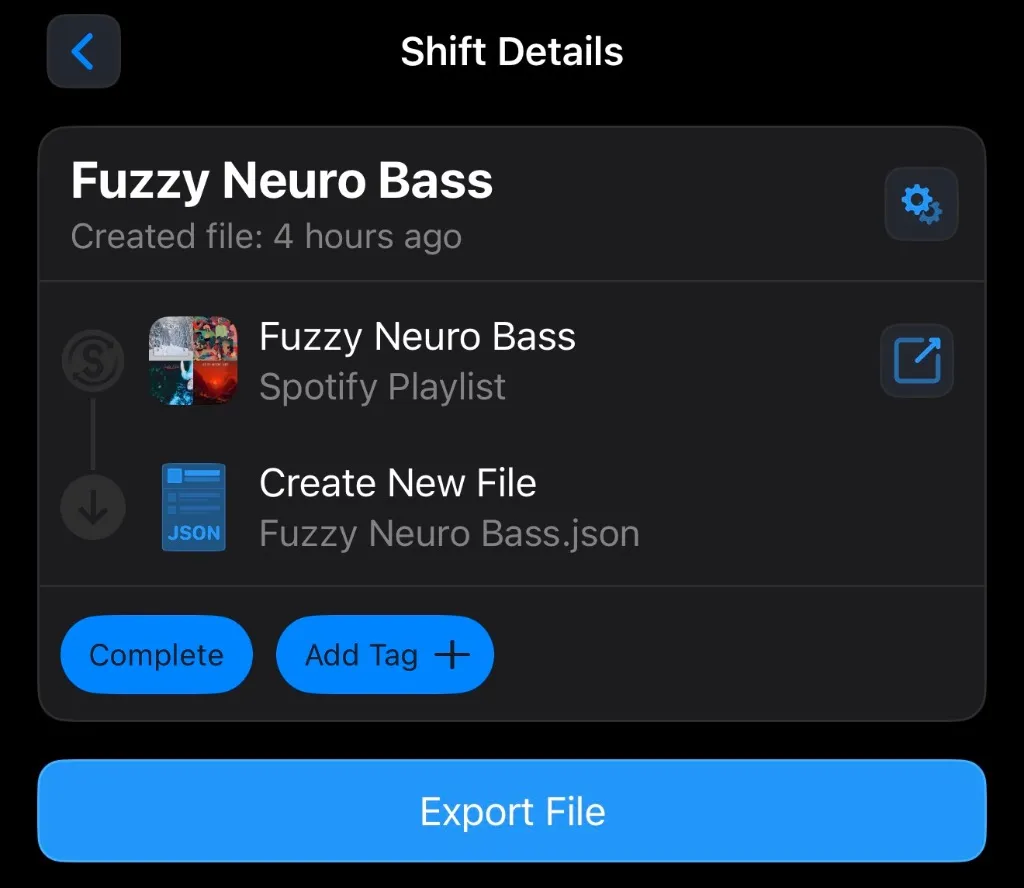
First, I prompted Spotify's AI playlist chat for fuzzy, neuro-bass electronic music, let it spin up Fuzzy Neuro Bass, and asked it to save the session. Instead of screenshotting thirty tracks one by one, I opened SongShift on my phone and exported the saved playlist as a structured Fuzzy Neuro Bass.json payload—giving me clean track names, albums, artists, ISRCs, and Spotify IDs in seconds.
2. Auditing & Sculpting in Google Antigravity (Orchestrator (Neon))
I pasted that raw JSON straight into Google Antigravity running Orchestrator (Neon)—Google's dual-phase planning-and-execution workflow powered by the brand-new Gemini 4 Neon model. Inside a single continuous thread, Antigravity researched tempos, harmonic keys, subgenres, and label relationships across all 30 tracks, flagged three genre-bleed outliers, researched eight studio-authentic additions to supply the missing neuro synthesis, rebuilt the entire running order into a five-act arc, and handed off cover generation to an image subagent to produce a 1:1 macro ferrofluid-and-moss sculpture with zero text or DJ clichés.
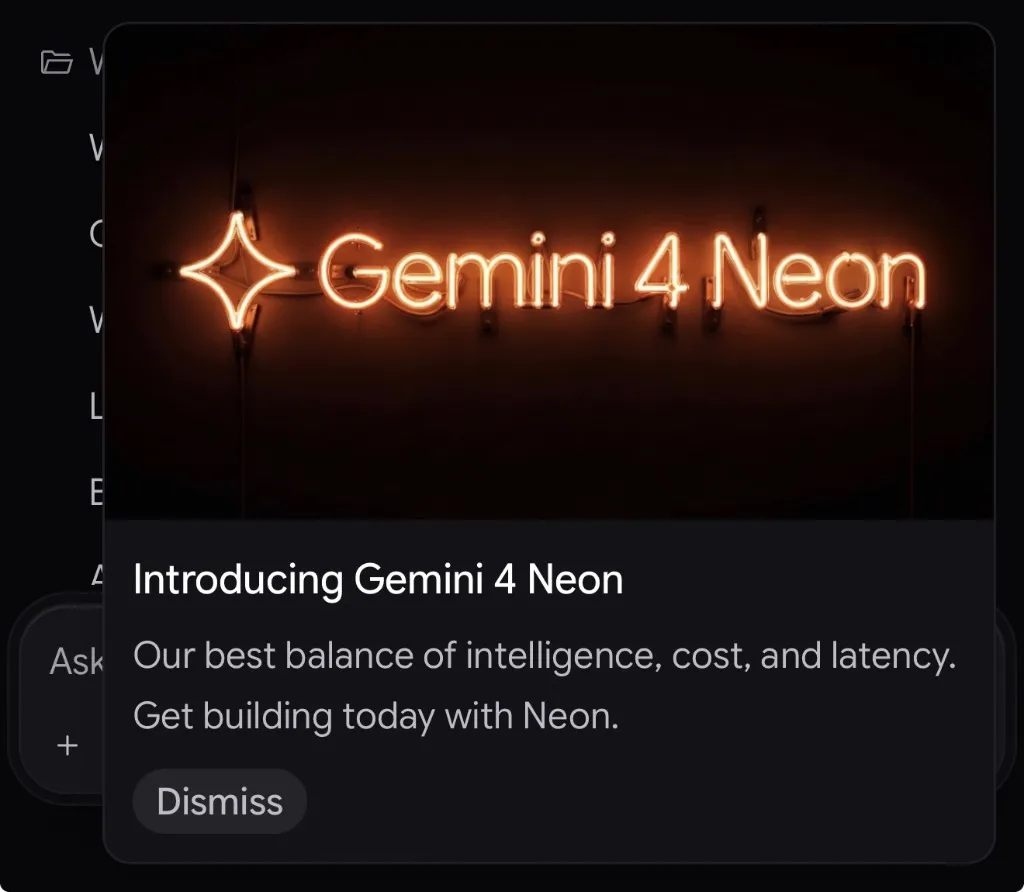
Launch-week stress test: driving the entire audit, cover-art pipeline, API deployment, and draft staging through Gemini 4 Neon in Orchestrator (Neon) mode.
3. The Away-From-Desk Constraint (Zero-Secret PKCE Pivot)
Once the curation report looked right, I asked Antigravity to push Velvet Static live on Spotify instead of leaving me to drag 35 tracks around manually. That hit an immediate real-world constraint: because I was away from my desk, hardware-backed local password-manager biometric approvals on the home workstation couldn't be clicked remotely.
Rather than waiting until Friday night or falling back to plaintext keys, Antigravity pivoted cleanly to Spotify's Authorization Code with PKCE flow:
- Zero secrets over chat or on disk: Using only my public app identifier, the local script generated an ephemeral SHA-256
code_verifierheld strictly in memory, sent me a single-use authorization link, and waited for the phone browser redirect URL. - Feb 2026 Spotify Web API compliance: Exchanging that one-time authorization code strictly in RAM, the script resolved all eight new tracks against Spotify's updated
limit=10Search behavior (verifying exact artist and original studio release matches before creating anything), created public Velvet Static via/v1/me/playlists, added all 35 URIs in exact five-act sequence via/items, compressed the custom cover artwork down to 98,924 Base64 bytes under Spotify's 256 KB ceiling, uploaded it, read everything back to verify 35/35 tracks and active cover art, and discarded the temporary token on exit.
4. Mirroring Back Out & Reviewing From an iPhone PWA
The moment Velvet Static went live on Spotify with its custom cover and 35-track sequence locked, two taps inside SongShift replicated the exact playlist—custom artwork and running order included—over to Apple Music and YouTube. Meanwhile, Antigravity scaffolded and validated this post directly inside my Astro repo, letting me inspect inline draft artifacts and +2 -2 file diffs right inside the Google Antigravity PWA on my iPhone—zero laptop required.
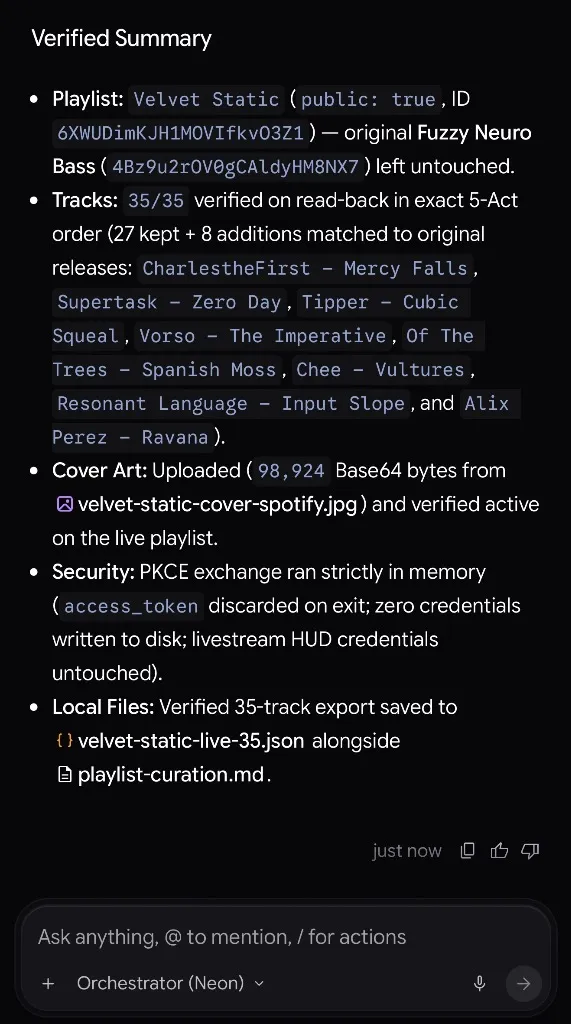
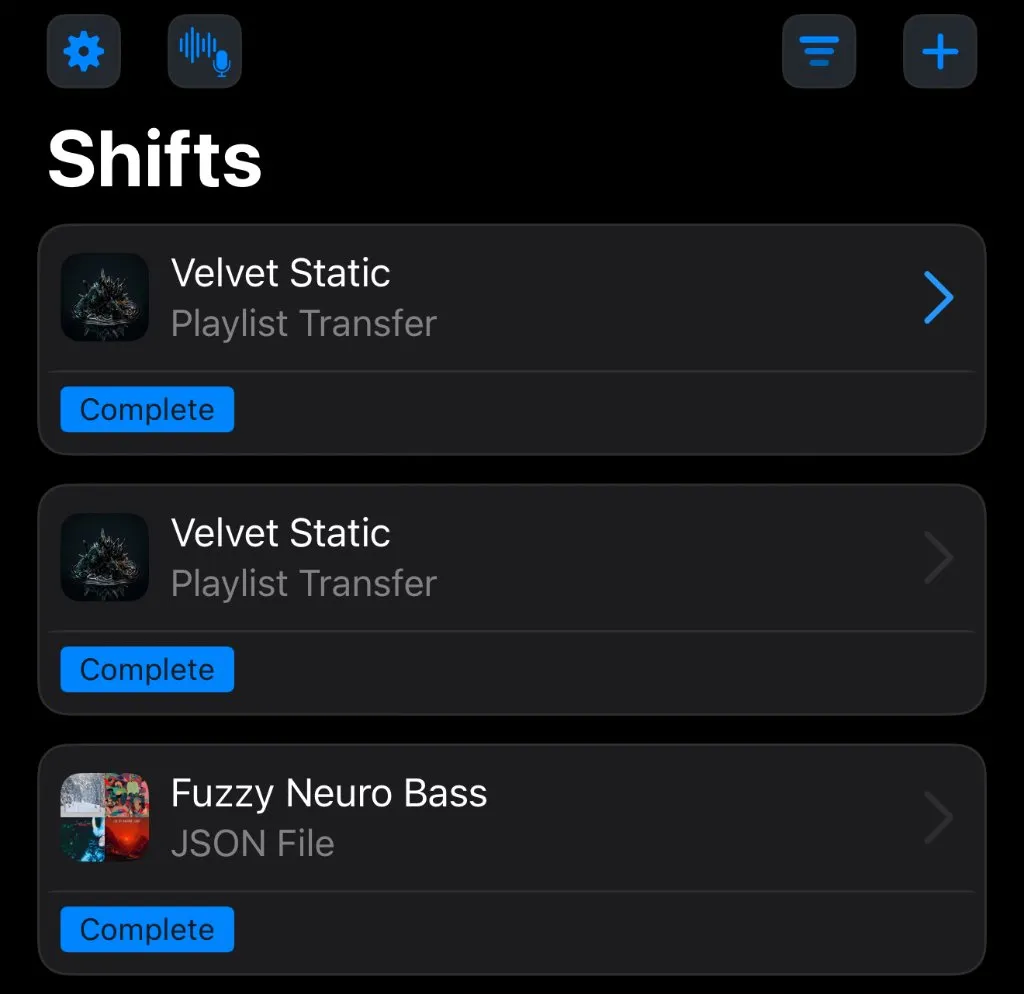
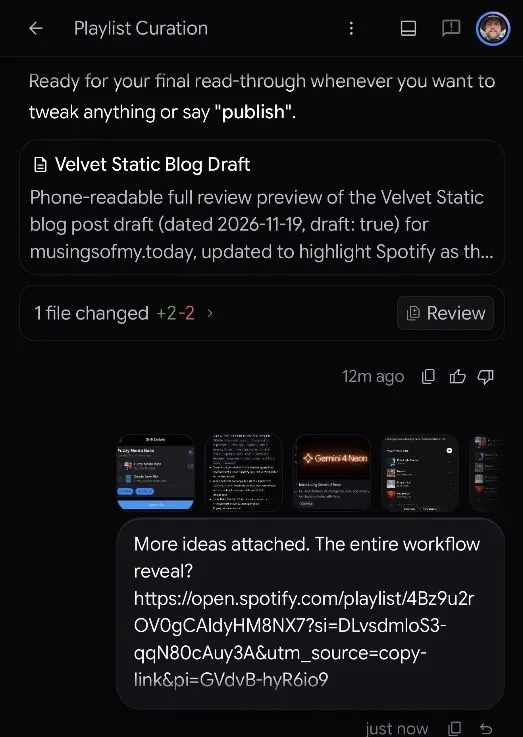
What Spotify AI Nailed—and Where Embeddings Bleed
What Spotify AI understood immediately was texture. Warm sine-compressed low-end, micro-edited percussion, mossy soundscapes, and deep sub pressure across Qualia, Odyzey, Gravitas, Shoshin, and Chikara Project orbits showed up naturally.
Where the raw 30-track draft stumbled boiled down to three classic algorithmic failure modes (if you want to A/B test it yourself, the original Fuzzy Neuro Bass playlist is still untouched):
-
Embedding bleed (the three cuts): Prompting with "fuzzy" and "dark" dragged in three adjacent-genre outliers that broke the rhythmic pocket:
- Jahrund – Blue Light Hunter (originally #1): German dark-pop and synthwave with alt-pop vocal framing. Opening a deep bass mix here immediately sets the wrong room.
- SIERRA VEINS – Gone (originally #9): French darksynth / EBM wedged directly between two 140 bass tracks (Dank Frank and Jungle Rootz). That rigid industrial drum grid collides hard with swinging halftime subs.
- Shadient – NOT ANYMORE (originally #28): Harsh, brickwalled industrial abrasion dropped right in front of meditative UK 140 (Mystic State).
Funny enough, two of those cuts were tracks I genuinely enjoyed on the initial playthrough. That is the quiet paradox of curating a sequence: a song can be great on its own and still sabotage the two tracks beside it. Keeping the original Spotify AI draft intact preserves those outliers where they belong, while Velvet Static commits to the cohesive lane.
-
Whiplash pacing: Robot Koch's ambient Instructions for Time Travel (Recue Remix) got burned at #6 like a random speed bump; Kindrid & Syberlilly's misty Autumn Fog landed stranded right after The Widdler's 140 dubstep weight; and the whole draft ended abruptly on peak-energy Mersiv – Digital Eden with no exhale.
-
Unspaced artist and label overlaps: Daggz appeared twice in four slots (Transmutation with Chmura at #21, then Magicians at #25), Lowcation appeared twice (Air Bender and the Recurring Dreams remix), and Huck.Jorris showed up in both Empathica and Saturna's Promise remix. Meanwhile, Chikara Project labelmates Jungle Rootz (Catharsis) and Mystic State (The Last Lotus) belong back-to-back as a deep 140 pivot rather than scattered nineteen tracks apart.
Earning the "Neuro" Half: The Eight Additions
The biggest surprise in the audit was how lightly Spotify AI actually touched neuro sound design. Roughly 75% of the original draft leaned psychedelic/downtempo space bass, while only a handful of tracks—KOAN Sound, Monuman, IMANU, Mindex, and Cut Rugs—carried true neuro-style synthesis and modulation.
To earn the name without abandoning the warm, fuzzy hypnosis of the original core, I added eight tracks across tempo hinges and peak textures:
| Artist | Track | Approx BPM / Feel | Role in the Sequence |
|---|---|---|---|
| CharlestheFirst | Mercy Falls | 80 / 160 BPM | Anchors the emotional organic-halftime spine straight into Chmura |
| Supertask | Zero Day | 110 BPM | Tactile, fuzzy midtempo bridge stepping cleanly out of CloZee – LOST |
| Tipper | Cubic Squeal | 88 / 176 BPM | Peak squelchy neuro sound design locked alongside Mindex – Zen |
| Vorso | The Imperative | ~86 / 172 BPM | Surgical halftime neuro-bass matching KOAN Sound's precision |
| Of The Trees | Spanish Moss | 154 / 77 HT | Missing organic centerpiece linking Monuman into his Pigeon Hole collab |
| Chee | Vultures | 140 BPM | Writhing, razor-edged neuro textures locked natively to 140 |
| Resonant Language | Input Slope | 146 BPM | Hyper-detailed micro-glitch climax bridging Lowcation and Ashez |
| Alix Perez | Ravana | 140 BPM | Dark 1985-style 140 neuro-dub weight bridging The Widdler into UK 140 |
(If you want an even grittier alternate pass, Frequent – Dream Recall (feat. Babokon), Culprate – Whispers, Pt. 1, and Two Fingers – Vengeance Rhythm (KOAN Sound Remix) all drop into Acts III and IV cleanly.)
The Five-Act Flight Plan
Rebuilding the 27 kept tracks alongside those 8 additions turns a flat shuffle into five deliberate movements—starting in ambient fog, warming up through midtempo static, locking into halftime neuro precision, cresting on heavy 140 subs, and decompressing back into mist.
Act I — Atmospheric Descent & Opening Mist (1–6 · 80–110 BPM)
Instead of stumbling out of the gate with dark-pop, Robot Koch's Recue remix opens the room slowly, letting Nyrus and illoh build organic low-end weight before CharlestheFirst and Chmura settle into an 80 BPM pocket and CloZee lifts the tempo to 110.
- Robot Koch, Savannah Jo Lack, Recue — Instructions for Time Travel - Recue Remix
- Nyrus, Serpentis — Ancient Secrets
- illoh, Orenda — Canmore Ceremony - Orenda Remix
- CharlestheFirst — Mercy Falls (+)
- Chmura, Daggz — Transmutation (spaced 27 slots from
Magicians) - CloZee, LSDREAM, Roniit — LOST
Act II — Velvet Fuzz & Hypnotic Midtempo Groove (7–14 · 110–124 BPM)
Supertask locks straight into LOST's 110 BPM pulse and hands the baton to Ferrofluid, Huck.Jorris, INZO, Swomp, and Lumasi as the basslines get thicker and wetter. Cut Rugs pulls the pocket down into halftime swagger before IMANU's orchestral A Taste of Hope - Hallowvale swings open the door to the neuro core.
- Supertask — Zero Day (+)
- Ferrofluid — Withholding
- Huck.Jorris — Empathica (spaced 25 slots from
Promise) - INZO, Blookah — Nexum
- Swomp — Alchemy
- Lumasi — Deep Inside
- Cut Rugs, Moff Mang — Dynasty
- IMANU — A Taste of Hope - Hallowvale
Act III — The Neuro-Halftime Core (15–20 · 86–89 HT / 154–176 BPM)
This is the sound-design spine of the playlist: Mindex, Tipper, KOAN Sound, and Vorso trading hyper-compressed, mutating bass patches at 86–89 BPM halftime before Monuman and Of The Trees bridge into 154–155 / 77 HT sway.
- Mindex — Zen
- Tipper — Cubic Squeal (+)
- KOAN Sound — Ascension
- Vorso — The Imperative (+)
- Monuman — Three Face
- Of The Trees — Spanish Moss (+)
Act IV — Deep 140 & Sub-System Peak (21–30 · 135–150 BPM)
Pigeon Hole & Of The Trees' Slow Craft pivots straight out of Spanish Moss into a ten-track 140 peak. Chee, Dank Frank, Lowcation, Resonant Language, and Ashez drive the top-end glitch tension to its crest on Mersiv's Digital Eden, before The Widdler, Alix Perez, and Jungle Rootz strip away the glare into pure, murky sub-bass authority.
- Pigeon Hole, Of The Trees — Slow Craft
- Chee — Vultures (+)
- Dank Frank — Type 33
- Lowcation — Air Bender (spaced 9 slots from
Recurring Dreams) - Resonant Language — Input Slope (+)
- Ashez, Gallium — Headway
- Mersiv — Digital Eden
- The Widdler — Obsidian
- Alix Perez — Ravana (+)
- Jungle Rootz — Catharsis
Act V — Sub-Surface Decompression & Misty Exhale (31–35 · 140 → Ambient)
Instead of dropping the listener off a cliff after peak energy, Mystic State picks up directly from Chikara Project labelmate Jungle Rootz, stepping gently down from 140 to 132 (Daggz, Josh Teed & Lowcation), down to 124 (Saturna & Huck.Jorris), and ending in the reclaimed atmospheric fog of Kindrid & Syberlilly's Autumn Fog.
- Mystic State — The Last Lotus
- Daggz, Comisar, Chmura — Magicians
- Josh Teed, Lowcation — Recurring Dreams - Lowcation Remix
- Saturna, Huck.Jorris — Promise - Saturna Remix
- Kindrid, Syberlilly — Autumn Fog
The Aesthetic: Ferrofluid Meets Velvet
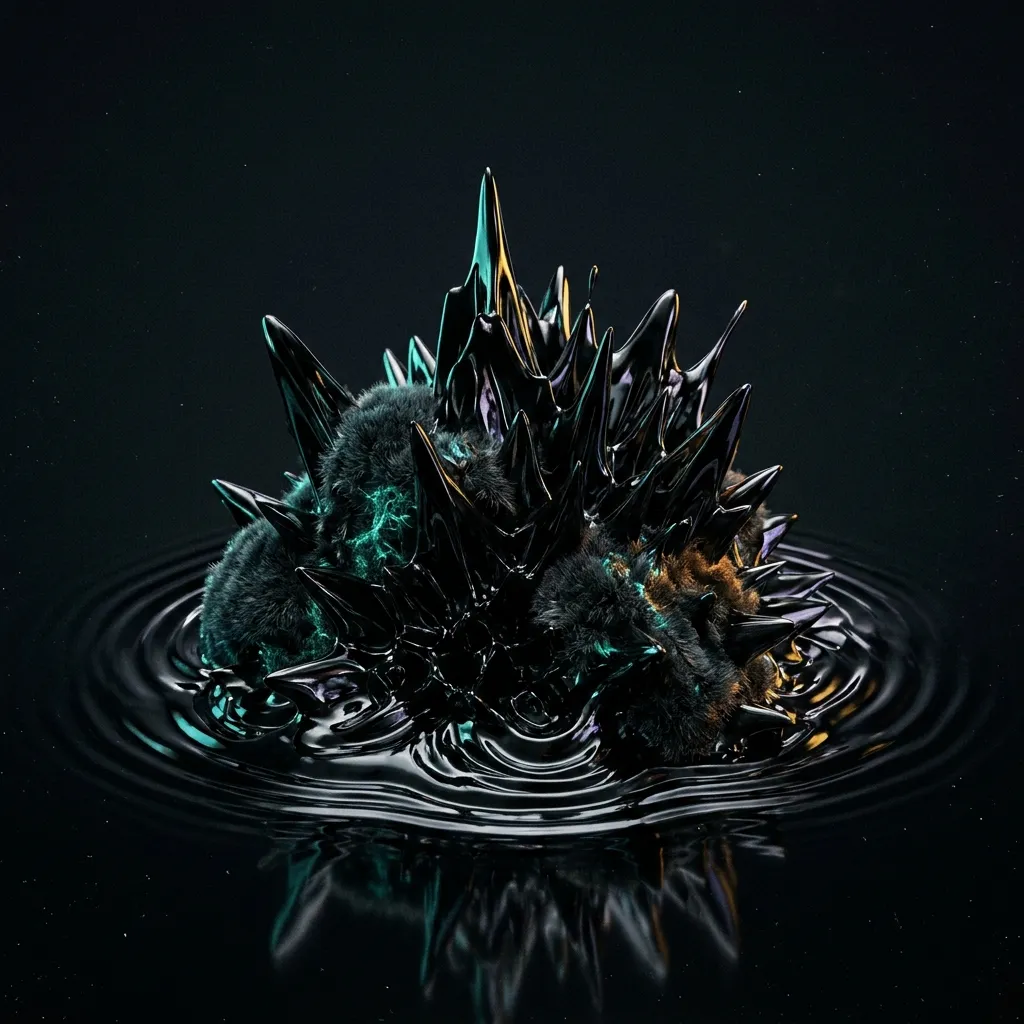
To match that split between surgical neuro synthesis and mossy halftime warmth, the cover skips the usual glowing headphones and neon grids: glossy jet-black magnetic ferrofluid spikes rising from concentric cymatic ripples on an obsidian mirror, tangled up in dark velvety bioluminescent moss with restrained electric teal, oxidized amber, and faint violet rim light. Sharp enough to feel the static; soft enough to sink into.
Listen Anywhere (Start on Spotify Mixed)
Once the 35-track sequence was locked on Spotify, I ran it through SongShift to mirror the exact order over to Apple Music and YouTube. Spotify is my preferred and recommended platform to listen, though—I enabled Spotify's Mixed feature on this playlist so the tempo hinges and five-act transitions blend seamlessly instead of breaking on hard track gaps. Wherever you press play, hear it front to back with shuffle turned off on decent headphones or a real subwoofer.
Compare Before vs. After: Original Spotify AI Draft ("Fuzzy Neuro Bass")
Want to hear the exact raw 30-track baseline before cutting the three darksynth/industrial outliers, adding the eight neuro tracks, and re-sequencing into five acts? Here is the untouched original playlist:
Which act hit hardest on your system—or which of the three algorithmic cuts would you have fought to keep in the mix?