New Podcast Launch: Welcome to The Architecture Archive (Plus a Little Feed Housekeeping)

If you’ve been following my work over on The Chronos Archive, you know I love deconstructing the systems that shape our world. But recently, it became clear that dropping a highly technical debate about software architecture right after an episode exploring the mysteries of the ancient world was… well, it was giving my listeners conversational whiplash.

History is the source code of our present, but the actual, literal source code needs its own home.

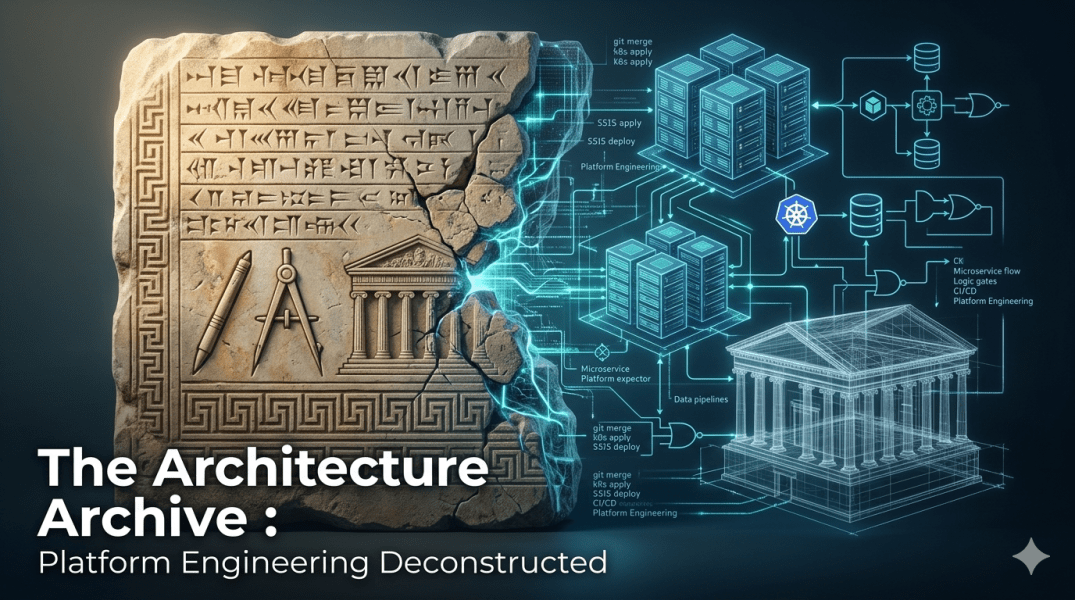
That’s why I’m thrilled to announce the launch of my new dedicated tech podcast: The Architecture Archive: Platform Engineering Deconstructed.

What is The Architecture Archive? Every scalable system starts with a blueprint. This new show is dedicated entirely to breaking down the architectural decisions driving modern DevOps and Platform Engineering. From wrestling legacy pipelines to architecting stateless microservices, we will analyze the structural trade-offs of enterprise tech.

Episode 1 is Live: The Great SSIS CI/CD Debate We are launching the feed today with a massive, 45-minute deep dive into one of the most notoriously frustrating aspects of enterprise data: SSIS CI/CD Pipeline Design. We stage a head-to-head debate between the “Modernist” (automated perfection) and the “Realist” (legacy constraints) to figure out how to actually standardize data pipelines without breaking existing integrations. You can listen to it right now on Spotify:

Housekeeping: Moving the Tech Episodes Because I want both of my podcasts to be highly focused, I am currently doing some manual feed migrations. Over the next few weeks, I will be moving all of my previous tech-heavy episodes off of The Chronos Archive and onto The Architecture Archive.

If you are looking for past episodes like:

  • The Architecture of Upgrades
  • Software-mageddon: The Great Bifurcation
  • The AI Reality Check
  • Wokepedia vs. Grokopedia
  • The 2038 Problem

…they will soon live exclusively on the new tech feed. The Chronos Archive will remain strictly dedicated to historical deep-dives, while The Architecture Archive will be your new home for engineering blueprints.

Thank you to everyone who has listened so far. If you build, automate, or maintain the platforms that engineering teams rely on, hit subscribe on the new show. Let’s get to work.


From Ticket-Taking to Platform-Building: Why We Are Pivoting to Product Mode

A Platform Engineering Manifesto

By: Kenneth Henseler, 15-FEB-2026

I’ve spent a lot of time in the trenches of IT Infrastructure. If you’ve been there, you know the drill: The “Ticket Factory.”

Developers need a server? Ticket.

Need a firewall rule? Ticket.

Need a database? Ticket.

For decades, this was the industry standard. It was safe. It was controlled. But in 2026, it’s also a bottleneck that kills velocity. When your smartest engineers spend 60% of their week manually executing repetitive tasks from a queue, you aren’t managing infrastructure—you’re managing a bureaucracy.

That’s why I’m leading a strategic shift in my organization: Moving from IT Service Management (ITSM) to Platform Engineering. We call it Project Polaris.

Here is the philosophy behind the shift, and why “Good IT” isn’t about closing tickets anymore—it’s about building products.

1. The “Ticket Factory” Doesn’t Scale

Traditional IT operations are linear. If you hire 10 more developers, you generate 10x more requests, which means you need 10x more sysadmins to handle the load. That math doesn’t work.

We are moving away from being “Gatekeepers” (who approve and implement) to becoming “Gardeners” (who cultivate the ecosystem).

The goal of our new Platform Engineering model is simple: Self-Service with Guardrails.

We are building an Internal Developer Platform (IDP) that treats our infrastructure as a product. If a developer needs a resource, they shouldn’t have to ask me for permission; they should be able to consume it via API or portal, knowing that the security and compliance checks are already baked in.

2. The “Golden Ratio” of Capacity Planning

One of the hardest lessons in engineering leadership is protecting your team’s time. If you don’t defend it, “keeping the lights on” (KTLO) will eat 100% of your bandwidth.

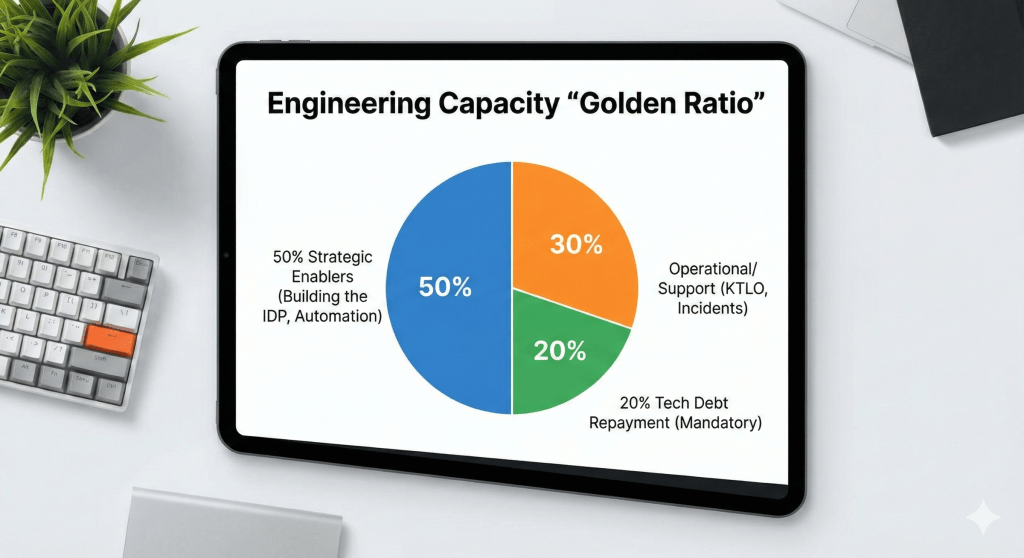
As part of this restructure, we are implementing a strict capacity model that I call the “Golden Ratio” for our sprints:

• 50% Strategic Enablers: Work that moves the business forward (Building the IDP, new architecture, automation).

• 30% Operational/Support: The inevitable day-to-day reality of running systems.

• 20% Tech Debt Repayment: Mandatory. Non-negotiable.

If you don’t explicitly budget for Tech Debt, you are essentially taking out a high-interest loan on your future stability. Eventually, the interest payments (outages, slow deployments, manual patches) will bankrupt your time.

3. Governance as Code (Safety Without Speed Bumps)

The biggest fear with self-service is usually security. “If we let devs provision their own DBs, won’t they leave them open to the internet?”

In the old world, we stopped this by having a human review every change. In the Platform world, we stop this with Governance as Code.

Instead of a manual approval board, we define our policies in the platform itself.

• You want an S3 bucket? Fine, but the platform automatically enforces encryption and private access policies before it’s even created.

• You need a VM? The image is pre-hardened and automatically patched.

We aren’t removing the rules; we are automating the enforcement. This allows us to say “Yes” faster, without lowering our security posture.

The North Star, Polaris

This transition isn’t easy. It requires a culture shift from “I own this server” to “I own the code that builds this server.”

But the destination is worth it. By treating our platform as a product, we stop being the “Department of No” and start being the accelerator that the business actually needs.

See you in the server room (or the repo).

– Ken