
Introduction: The Dark Side of Tradition
In the high-church of premium tobacco, tradition often acts as a straitjacket. For generations, the conventional wisdom of the tabaquero has been immutable: a Maduro cigar, defined by its dark, resinous, and heavily fermented wrapper, must be balanced by a lighter interior. Because these oil-saturated leaves naturally inhibit oxygen flow, blenders have historically relied on thinner leaves for the binder and filler to ensure the cigar remains combustible. To build a cigar entirely of Maduro leaf was, according to the laws of agronomic physics, to build a non-burning stick of charcoal.
The Camacho Triple Maduro did not merely challenge this thermodynamic limit; it systematically dismantled it. By utilizing deeply fermented Maduro tobacco for every structural component—a Mexican San Andrés wrapper, a Honduran Corojo binder, and a multinational filler matrix sourced from Brazil, the Dominican Republic, and Honduras—Camacho created a disruptor that shattered the rules of the industry.
Listen to the full audio deep-dive of this article on The Chronos Archive:
Takeaway 1: The “Impossible” 84-Trial Marathon
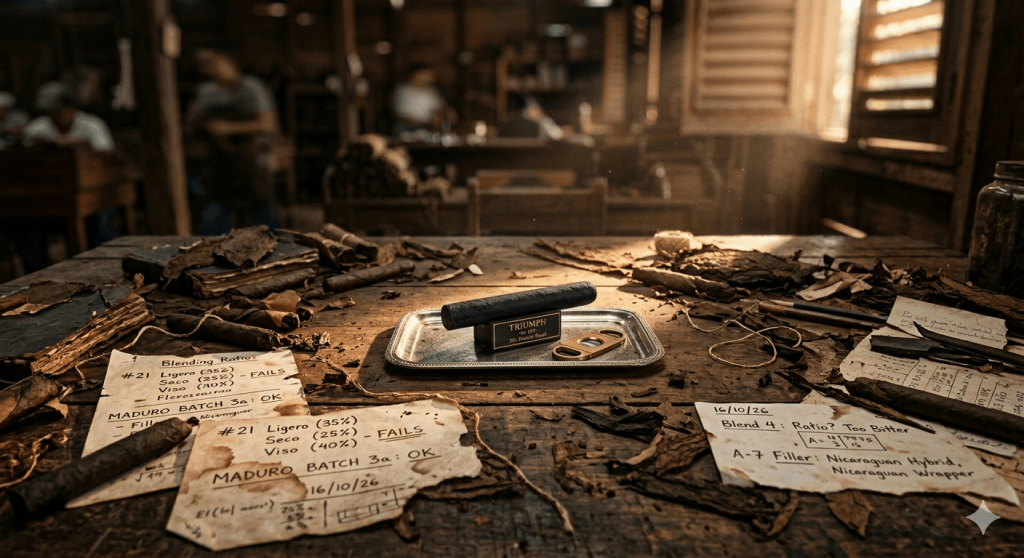
The genesis of the Triple Maduro was not born in the fields, but in a moment of professional audacity. Sal Fontana, the brand’s trusted “consigliere,” and a friend proposed the “impossible” all-Maduro concept to then-president Christian Eiroa. Christian’s initial reaction was one of pure skepticism, rooted in the botanical reality that such a dense construction would likely result in an unsmokeable nicotine bomb.
The development process became a nine-month endurance test of internal engineering. Christian turned to his father, Julio Eiroa—the undisputed mastermind of the Jamastran Valley fields—to help solve the combustion crisis. While most manufacturers abandon a failing blend after a handful of attempts, the Eiroa team persisted through 83 distinct iterations that failed to burn, failed to draw, or lacked flavor clarity. It was only on the 84th trial that they achieved the perfect organoleptic balance.
“The idea was intriguing, but the problem was, How do you blend a cigar where the wrapper, binder and filler is maduro? I said it can’t be done.” — Christian Eiroa
Takeaway 2: The Spy-Movie Origin of the “Authentic Corojo” Seed
The “engine” driving the Triple Maduro is the Authentic Corojo seed, a botanical masterpiece with a history as dramatic as its spicy profile. Developed in 1940s Cuba by Diego Rodriguez, the strain was a genetic cross-pollination of a Mesoamerican Criollo strain and an Indonesian Sumatra. Following the Cuban Revolution, the state-run industry began prioritizing disease-resistant hybrids, which were resilient but lacked the nuanced flavor of the original.
Recognizing that this unadulterated lineage was at risk of extinction, Diego’s son, Daniel Rodriguez, meticulously smuggled viable seeds out of Cuba. These contraband seeds found their way to the Eiroas in Honduras, where they underwent a grueling 40-year adaptation process to harmonize with the volcanic soils of the Jamastran Valley. This was more than farming; it was a decades-long rescue mission to preserve a pedigree specimen of pre-embargo tobacco history.
Takeaway 3: Engineering Airflow via “Powerband” Internal Architecture
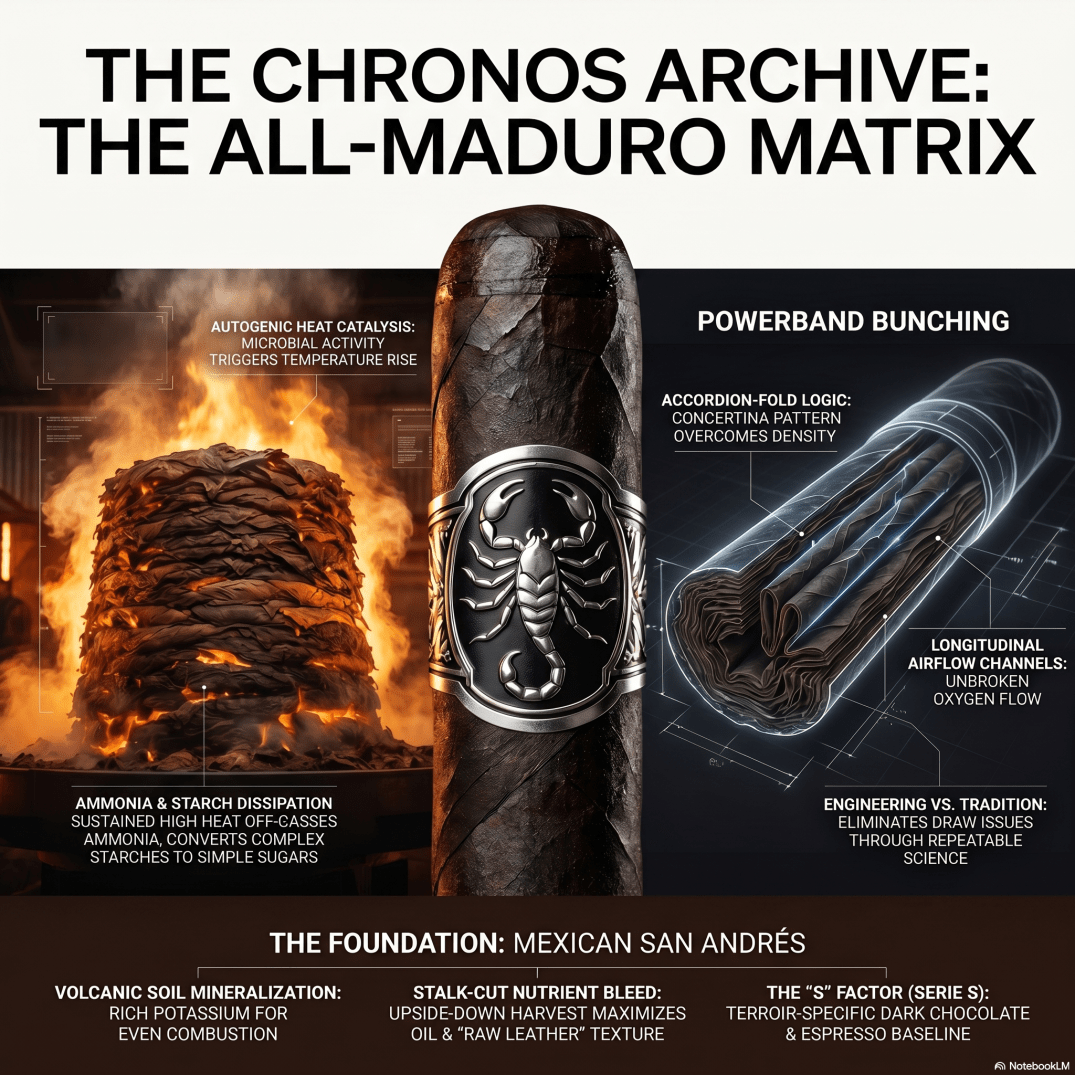
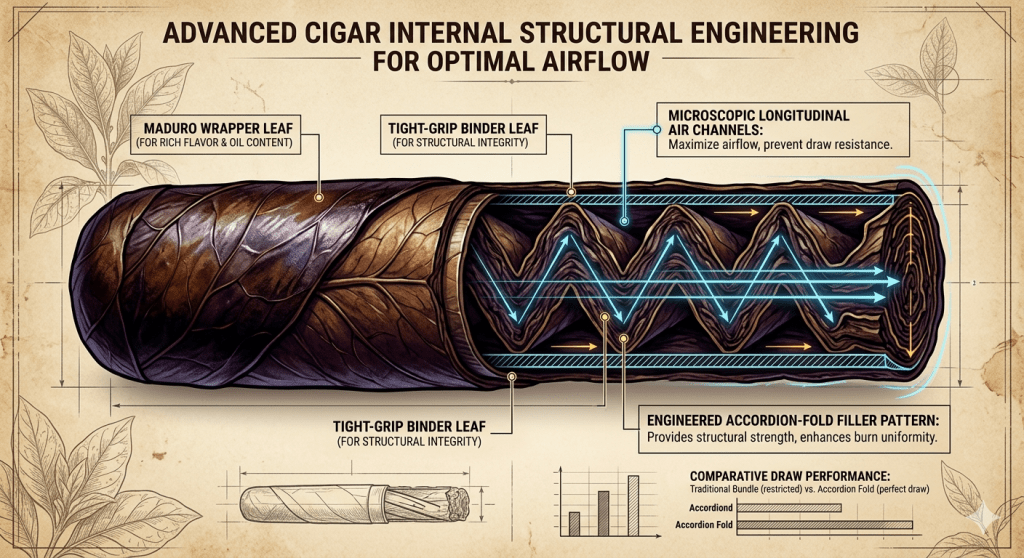
Even with the perfect 84th blend, the physical density of the Triple Maduro presented a mechanical crisis. Traditional rolling utilizes a “snail’s shell” pattern—a circular bunching that creates pockets easily blocked by the heavy oils of high-priming leaves. To solve this, Camacho engineered “Powerband bunching,” a highly secretive method of internal structural engineering where the fillers are folded in a “concertina” or accordion pattern.
This technique ensures the cigar is perfectly constructed with no soft spots, creating optimized airflow for a perfect draw. To further stabilize this architecture, the binder is specifically selected from the 5th priming of the Authentic Corojo plant. This unusually high priming provides a rugged structural grip and a concentrated kick of spice directly at the burn line. Without these innovations, the vitola would succumb to fatal physical failures like tunneling or canoeing.
Takeaway 4: The Counter-Intuitive Sweetness of the Pilon
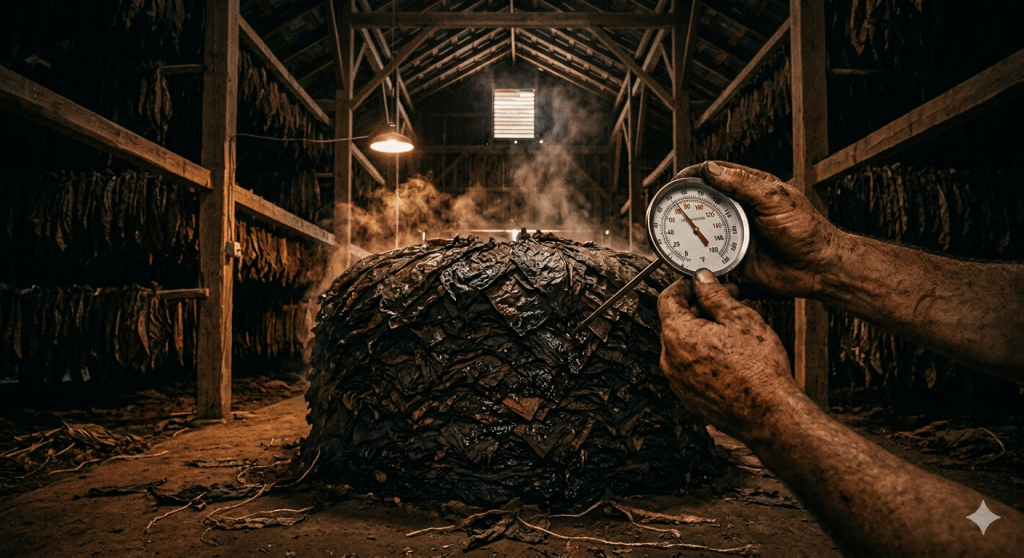
There is a prevailing myth among novices that the darkest cigars are the harshest. The science of the pilon—the massive, compost-like heaps of fermenting tobacco—proves the opposite. For the Triple Maduro, the leaves undergo a “brutal” fermentation where temperatures are strictly monitored to reach an optimal 110 to 115 degrees Fahrenheit. This sustained heat triggers a vital biochemical transformation, dissipating moisture and releasing ammonia from the leaves over a process that lasts weeks or months.
The resulting organoleptic profile is surprisingly velvety. The leathery texture of the Mexican San Andrés wrapper gives way to a decadent cold draw of dark fruit and fig newton sweetness. To prevent the smoke from becoming bland and confused, the blend utilizes a multinational matrix including Brazilian and Dominican fillers that harmonize the aggressive Corojo spice.
Takeaway 5: A Pedigree Fit for a Prime Minister
While the modern Camacho brand is defined by its “Live Loud” identity—associated with bikers, tattooed rogues, and the iconic scorpion—its origins are remarkably aristocratic. The brand was founded in 1961 by Simon Camacho, a Cuban exile whose Miami-rolled cigars were so exceptional they earned the devotion of British Prime Minister Winston Churchill.
This creates a fascinating tension for the historian: the Triple Maduro is a rule-breaking, high-tech innovation, yet it carries the pedigree of a brand once favored by history’s most discerning world leader. After the Oettinger Davidoff Group acquired Camacho in 2008, the brand embraced its bold new identity while implementing world-class Good Manufacturing Practices (GMP) and Good Agricultural Practices (GAP), becoming a bridge between old-world obsession with quality and new-world disruption.
Conclusion: The Legacy of a Rule-Breaker
The Camacho Triple Maduro stands as a definitive watershed moment in tobacco history. It proved that the perceived boundaries of agronomy and thermodynamics are often just traditions waiting to be challenged by those with enough stubbornness to ignore them. By marrying the mineral-dense power of the Jamastran Valley with the engineering precision of Powerband bunching, Camacho didn’t just create a new cigar; they redefined the blending paradigm for the entire industry.
It leaves the aficionado with a compelling thought: true innovation rarely arrives on the first attempt. It requires a willingness to face 83 consecutive failures in the unwavering pursuit of the 84th, and “impossible,” success.
Sources Cited:
- Bespoke Unit – Camacho Brand History and Technical Cigar Making: Details on the exile of Simon Camacho, the Eiroa family’s Honduran operations, the preservation of the Authentic Corojo seed, and the proprietary Powerband bunching technique.[1]
- Cigar Aficionado – Camacho Triple Maduro: Historical coverage of the 84 trial blends, Sal Fontana’s initial pitch, and Christian Eiroa’s development process for the all-Maduro concept.[2]
- Casa de Montecristo – Camacho Triple Maduro: Specifications on the multinational maduro leaf selection, the Mexican San Andrés wrapper, and the cigar’s robust flavor profile.[3]
- Famous Smoke Shop – Cigar Tobacco Fermentation: Agronomic science detailing the pilon fermentation process, optimal heat thresholds (110-115°F), and the biochemical off-gassing of ammonia.[4]
- The Dapper Man – Cigar Review: Camacho Triple Maduro: Organoleptic analysis, pre-light cold draw notes (fig newtons, dried dark fruit), and smoking experience breakdowns.[5]
- Kohnhed – Camacho Corojo Maduro Cigar Review: Technical breakdown of the Authentic Corojo primings, specifically the use of high-resilience 5th priming leaves for structural binders.[6]
Discover more from Musings of My Today
Subscribe to get the latest posts sent to your email.
