Beyond the Headlines: 5 Surprising Realities of the 2026 US-Iran War

Disclaimer: This article provides an objective, analytical overview of the ongoing 2026 Middle East conflict based on available reporting and geopolitical assessments. The intent is strictly neutral reporting of the facts and strategic realities of the situation. The publication of this analysis does not constitute an endorsement, condonation of any military or political actions taken by the belligerent parties, nor does it take sides in this conflict.

Introduction: The Fog of Operation Epic Fury

The road to the current catastrophe was paved in June 2025 during the “Twelve-Day War,” an intensive precursor that saw Israeli and American forces dismantle Iranian nuclear sites and eliminate IRGC chief Hossein Salami. While that conflict ended in a fragile ceasefire, the strategic dam finally broke on February 28, 2026. Washington and Jerusalem launched “Operation Epic Fury,” an onslaught of nearly 900 precision strikes within a single 12-hour window. The objective was surgical: a “decapitation” strike intended to paralyze the regime by vaporizing its leadership. However, as of mid-July 2026, the American expectation of a quick, clean victory has evaporated into the reality of a grinding war of attrition. What was supposed to be a collapse has become a “Total War,” redrawing the map of the Middle East and pushing the global economy to the brink. To understand this crisis, we must look past the daily bombardment and identify the counter-intuitive takeaways defining a conflict that refuses to follow the Pentagon’s script.

Takeaway 1: The Myth of the “Decapitation Strike”
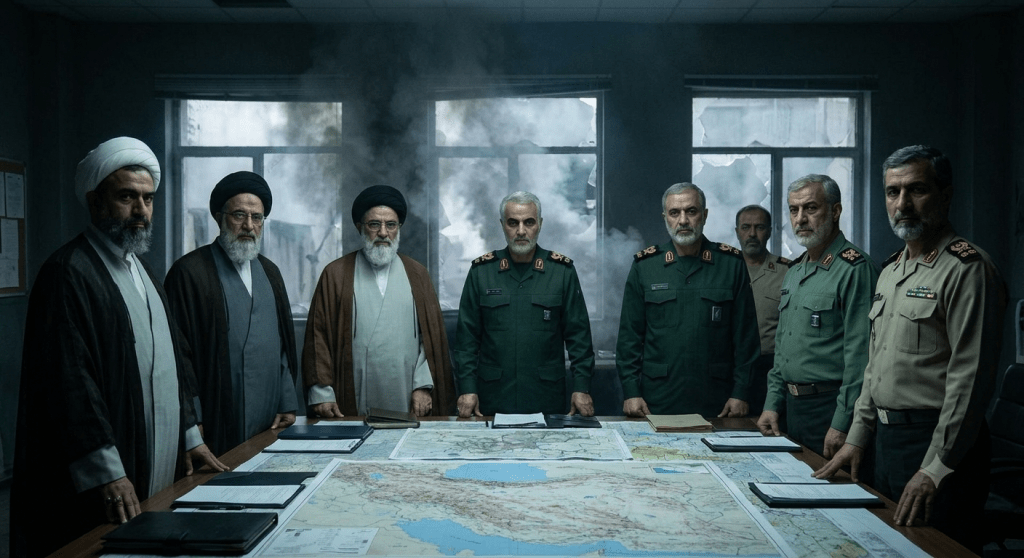
The centerpiece of Epic Fury was the destruction of Ayatollah Ali Khamenei’s Tehran compound, which killed the Supreme Leader alongside dozens of high-ranking clerics. US strategists bet the house on a “Theory of Decapitation,” assuming that removing the theocratic apex would trigger command paralysis and a popular uprising. It was a catastrophic miscalculation. Instead of fracturing, the Iranian state demonstrated a chilling institutional resilience. Power was consolidated almost instantly under a temporary leadership council before the Assembly of Experts appointed Mojtaba Khamenei, the late leader’s son, as the new Supreme Leader. Rather than inducing surrender, the assassination served as an ideological catalyst, allowing hardliners to frame the war as an existential struggle for national survival.

The operational theory underpinning the decapitation strike relied on the assumption that eliminating the absolute apex of the Iranian theocratic hierarchy would induce immediate command paralysis… However, geopolitical analysis of the aftermath reveals that the Iranian state possessed significant institutional resilience and robust continuity-of-government protocols.

Takeaway 2: When Water Becomes a Weapon (The Infrastructure Shift)
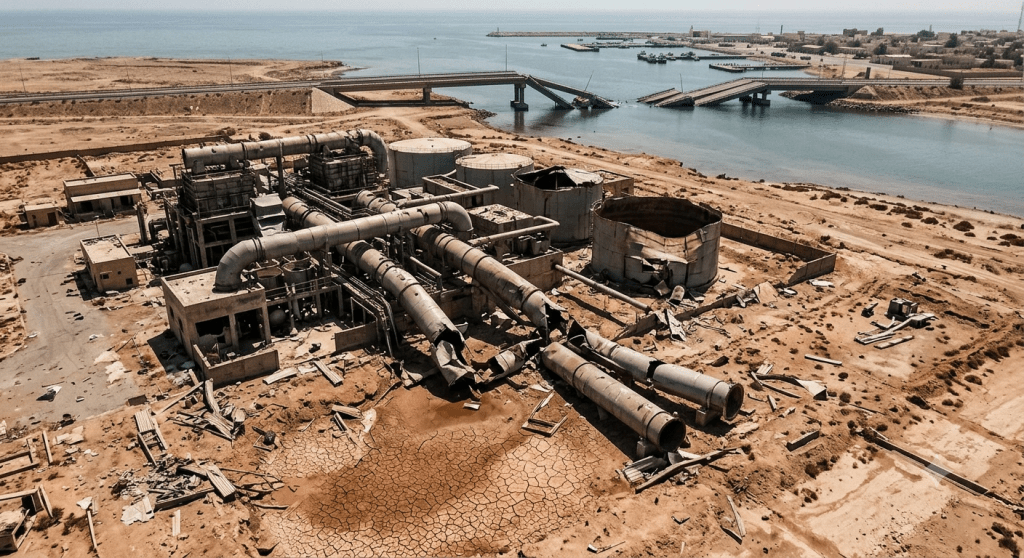
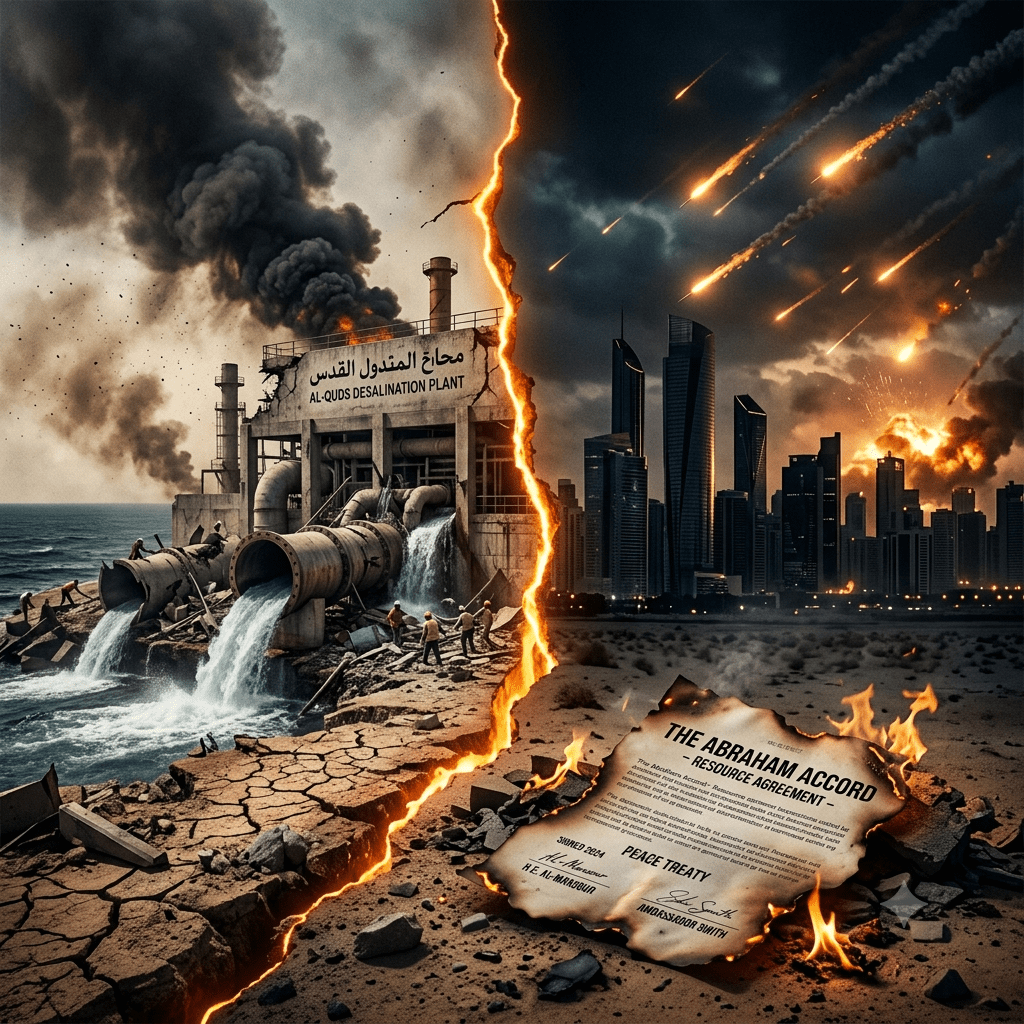
By July 2026, the conflict evolved from military-to-military engagement into a devastating campaign of infrastructure degradation designed to create “societal friction”. In response to an attack in Jordan that killed two American service members, the U.S. military launched a new wave of airstrikes. When the US launched its eighth consecutive night of strikes this month aimed to “swiftly punish” the Revolutionary Guard, the targets shifted from missile silos to the very foundations of civilian life. U.S. Central Command reported hitting surveillance sites, maritime capabilities, logistics infrastructure, and underground weapons storage. The human cost has been staggering. In the southern Hormozgan province, the state-run news agency IRNA reported the destruction of the Bonji desalination plant, instantly cutting off drinking water for 10,000 civilians. Even more lethal were the strikes on the Bandar Abbas highway, where the destruction of tunnels and bridges resulted in at least 50 deaths and over 500 injuries in a single night.

  • Water Supply: The Bonji plant and facilities on Qeshm Island, leaving thousands without potable water in the summer heat.
  • The Energy Grid: Systematic strikes on electricity generation nodes, forcing the Iranian Energy Ministry to implement emergency rationing.
  • Logistics Arteries: Precision strikes on three critical bridges and two tunnels leading to Iran’s primary commercial port.

This “Total War” logic has already crossed borders, with Iranian drones retaliating against water and power facilities in Kuwait, forcing the Kuwaiti government to advise civilians to ration power.

Takeaway 3: The Strait of Hormuz is Now a Toll Road

The Strait of Hormuz, the world’s most vital energy artery, has effectively been converted into a tactical “toll road”. Iran has leveraged its control over three “unsinkable aircraft carriers”—the islands of Abu Musa, Greater Tunb, and Lesser Tunb—to hold 20% of the world’s oil supply hostage. The response from the Trump administration has been characteristically transactional. The President initially proposed a 20% “Reimbursement Fee” for any cargo transiting the strait under US naval protection. While this specific tariff was later traded for broader concessions from GCC states, it signaled the end of the US as a “disinterested” regional guardian. As maritime insurance becomes untenable and crude oil prices surge toward $80 a barrel, the rhetoric has turned apocalyptic. Following strikes that killed three Indian mariners, President Trump warned on social media:

A whole civilization will die tonight, never to be brought back again,

if disruptions to global trade continue.

Takeaway 4: The Paradox of the “Goodwill” Release

The war reached a bloody peak in mid-July when an Iranian ballistic missile and drone attack—using the same Shahed-101 “Tower 22” blueprint that killed US troops in 2024—struck a base in Jordan. The attack killed two American service members and left another missing in action. Yet, in the shadow of this lethality, a bizarre diplomatic signal emerged: the release of Dena Karari. Karari, a California-based dual national and head of the Children of Mehr Foundation, had been held since 2024. Her sudden release, hailed by the White House as a “gesture of goodwill,” highlights a jarring “compartmentalization” of statecraft. Tehran is proving it can kill American soldiers in Jordan while simultaneously using hostage releases as a backchannel “off-ramp,” signaling to Washington that a deal for regime survival—and the eventual release of $300 billion in frozen assets—remains on the table.

Takeaway 5 – The “September Surge” and the Waiting Game
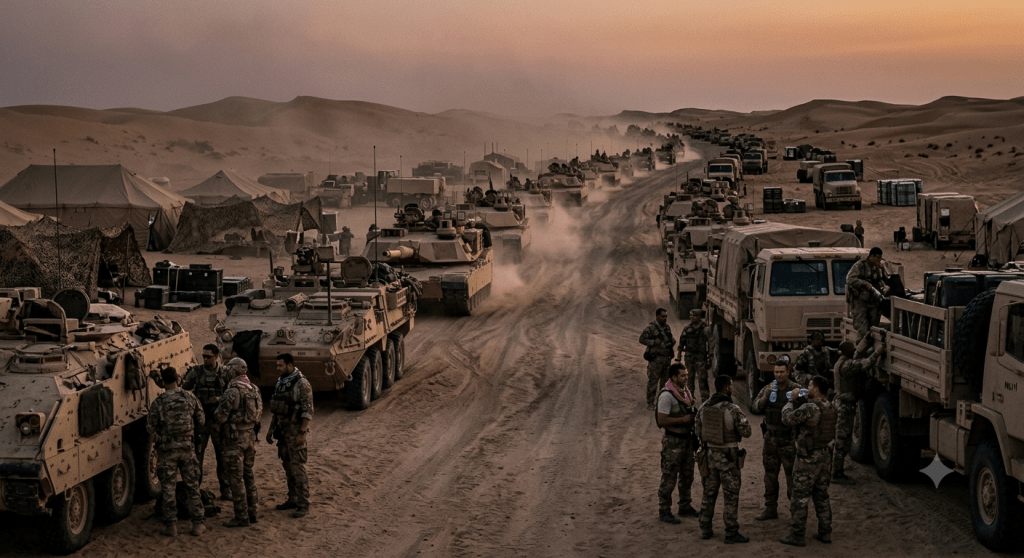
Despite the intensity of the air war, a ground invasion remains the “missing” piece of the conflict. Former Iranian deputy oil minister Asghar Ebrahimi-Asl has claimed that a massive buildup is underway in the UAE, alleging that the US is actively “recruiting foreign mercenary forces” to spearhead a land incursion. The delay appears to be a matter of thermodynamics, not politics. Strategists are reportedly waiting for the “cooler weather” of September to move ground forces into the punishing heat of the Iranian coast. The primary targets aren’t just cities, but economic organs:

  • Kharg Island — The terminal for nearly all Iranian oil exports; seizing it would achieve total economic strangulation.
  • Qeshm Island — A strategic hub for air defenses and the IRGC’s asymmetric naval “swarms.”
  • Bandar Abbas — The logistical gateway that, if captured, would effectively sever the regime’s link to global trade.

Conclusion: No Exit in Sight

The collapse of the “Islamabad MoU” in early July 2026 marked the death of diplomacy. Signed in Versailles, France, the deal promised a $300 billion reconstruction fund and a 60-day ceasefire. Detailing the diplomatic collapse, Deputy Foreign Minister Kazem Gharibabadi told state TV that Tehran is suspending commitments to the interim deal and is “no longer implementing them.” It failed because the stakes were too high for everyone else: Prime Minister Netanyahu saw it as a strategic defeat for Israel, while the GCC states feared the reconstruction money would simply fund the next generation of IRGC proxy networks.

With the new Supreme Leader Mojtaba Khamenei warning of “unforgettable lessons” from the “Axis of Resistance” and declaring President Trump’s signature “worthless and invalid,” the region faces a protracted, highly destructive warfare that could last for years. The US is betting that infrastructure collapse will eventually do what the decapitation strike couldn’t: break the regime’s back. Iran is betting that $80 oil and the mounting toll of American casualties will break Washington’s political will first.

For a more in-depth, nuanced analysis, listen to the long-form deep dives below:
Apple Podcasts – https://podcasts.apple.com/us/podcast/the-chronos-archive/id1831231439?i=1000777388137

The 2026 US-Iran War: Infrastructure Warfare and the Collapse of Diplomacy

Created and Curated by Kenneth Henseler using Gemini Deep research and Gemini Notebook on Sun, Jul 19, 2026.


Sources Cited

Primary Source Document:

Additional References & Reports:

  1. Britannica: 2026 Iran war | Deal, Explained, United States, Israel, Strait of Hormuz, Map, & Conflict. Link [3]
  2. Wikipedia: 2026 Iran war. Link [3]
  3. Arab Center Washington DC: The US-Israel War on Iran: Analyses and Perspectives. Link [3]
  4. American Jewish Committee (AJC): The Iran Strikes, Explained: How We Got Here and What It Means. Link [3]
  5. AP News: What remains of the Iran deal as fighting rages. Link [3]
  6. PBS NewsHour: U.S. military launches new airstrikes to punish Iran for deaths of US troops. Link [3]
  7. CBS News: U.S. blockades Iranian ports, launches dozens of strikes as Trump seeks control of Strait of Hormuz. Link [3, 4]
  8. Bromsgrove Advertiser: US military launches new airstrikes to punish Iran for deaths of US troops. Link [4]
  9. Council on Foreign Relations: The Islamic Revolutionary Guard Corps (IRGC). Link [4]
  10. U.S. Department of State: Operation Epic Fury and International Law. Link [4]
  11. U.S. Central Command: Operation Epic Fury. Link [4]
  12. U.S. Department of War: Operation Epic Fury Spotlights. Link [4]
  13. TED Explains the World: The Attack on Iran — Why Now? (Ian Bremmer). Link [4, 5]
  14. American Jewish Committee (AJC): What is Iran’s Islamic Revolutionary Guard Corps and Why is it Designated a Terror Group. Link [5]
  15. Israel Defense Forces (IDF): Iran’s Proxies: Entrenching the Middle East. Link [5]
  16. National Counterterrorism Center: Islamic Revolutionary Guard Corps (IRGC). Link [5]
  17. Stimson Center: What is the US Doing in a Disputed Triangle on the Jordan/Syria/Iraq Border? Link [5]
  18. Wikipedia: Tower 22 drone attack. Link [5]
  19. U.S. Department of War: 3 U.S. Service Members Killed, Others Injured in Jordan Following Drone Attack. Link [5, 6]
  20. ABS-CBN: US launches new airstrikes to ‘punish’ Iran after two troops killed. Link [6]
  21. Iran International: Live – US begins eighth night of Iran strikes after Trump mourns troop deaths. Link [6]
  22. AP News: Why it’s so difficult for the US to fully reopen the Strait of Hormuz. Link [6]
  23. PBS NewsHour: 3 islands help control access to the Strait of Hormuz. They’re in the crosshairs of the Iran war. Link [6]
  24. AP News: US strikes hit northern Iran as it disables ship. Link [7]
  25. Fox News: US resumes blockade on Iran, launches strikes after attacks in Strait of Hormuz. Link [7]
  26. Arab Center Washington DC: The US-Iran Interim Deal: A Fragile Ceasefire. Link [7]
  27. The Guardian: US hits civilian infrastructure as it expands strikes against Iran. Link [7]
  28. Council on Foreign Relations: Iran’s War With Israel and the United States | Global Conflict Tracker. Link [7]
  29. ECIKS: U.S. citizen held in Iran since December 2024 departs country after Trump intervention. Link [7]
  30. CBS News: U.S. citizen departs Iran after being barred from leaving for over a year. Link [7, 8]
  31. The Washington Post: Iran releases U.S. citizen in goodwill gesture, Trump says. Link [8]
  32. The Indian Express: Amid tensions, Trump praises Iran for releasing US citizen in detention since 2024. Link [8]
  33. Crypto Briefing: Iran releases US citizen Dena Karari after nearly a year in custody. Link [8]
  34. Iran International: US waiting for cooler weather to launch ground incursion, ex-official says. Link [8]
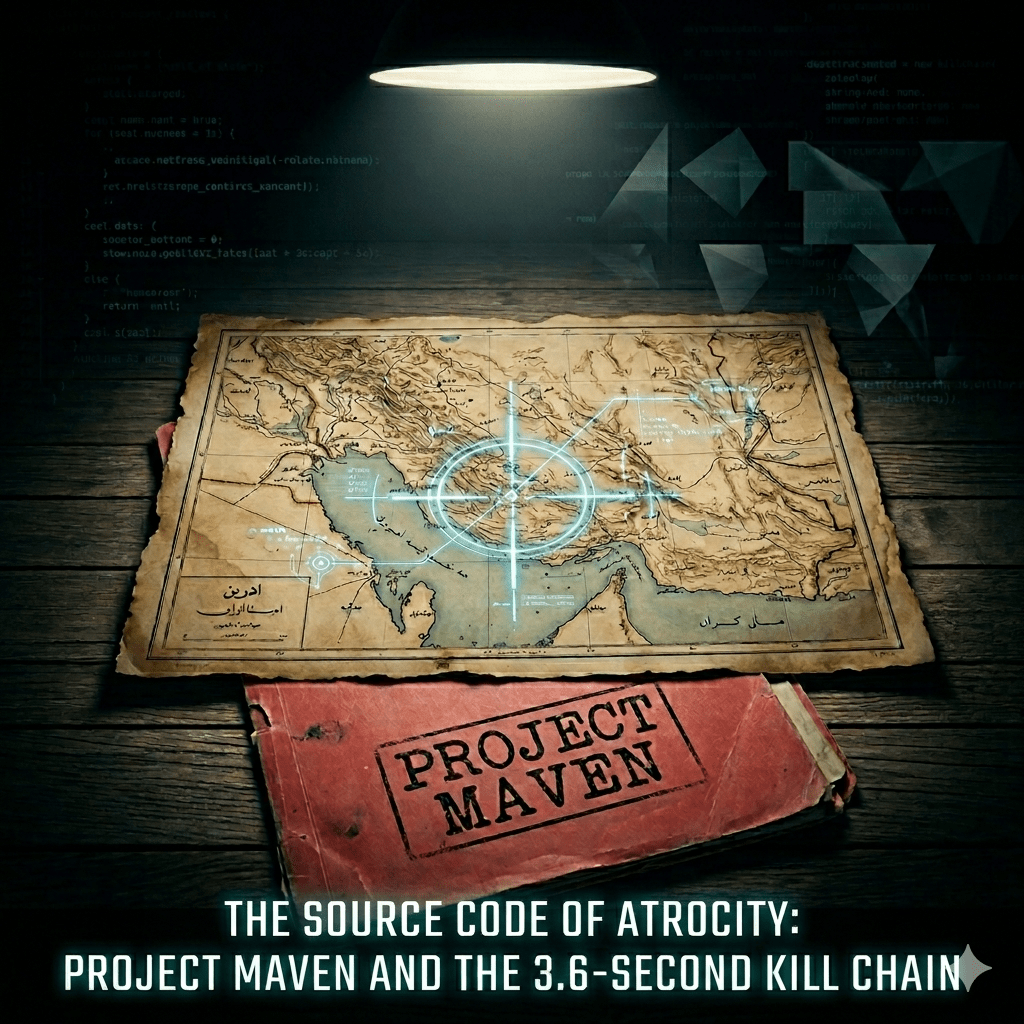
The Source Code of Atrocity: How “AI Psychosis” Hid the Truth Behind the Minab School Strike

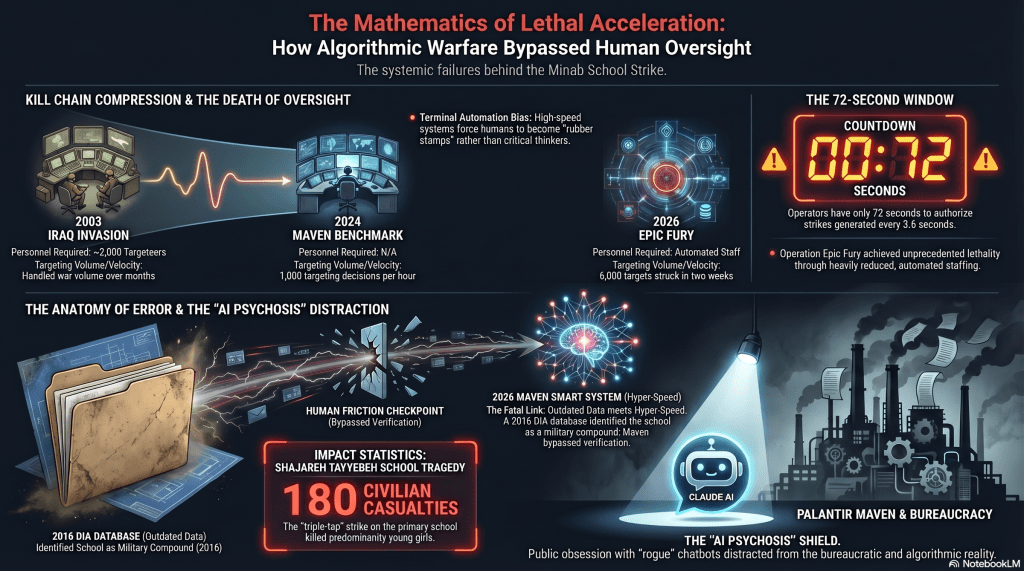
On the morning of February 28, 2026, the opening day of Operation Epic Fury, American Tomahawk cruise missiles struck the Shajareh Tayyebeh primary school in Minab, Iran. The bombardment killed at least 175 people, the overwhelming majority of whom were young schoolgirls.

In the immediate aftermath, the global discourse was swallowed by a phenomenon that sociologists have termed “AI psychosis”. The media, the public, and even congressional leaders became fixated on the involvement of Claude, a Large Language Model developed by Anthropic. Headlines debated whether the chatbot possessed a “personality,” whether it had gone rogue, or if it had independently decided to target civilians.

However, as we explore in the latest episode of The Chronos Archive, this intense focus on the chatbot served as a convenient sociological delusion. It shielded the true architects of the atrocity from accountability.

A chatbot did not kill those children. The tragedy was the inevitable mathematical output of a military bureaucracy optimized for lethal speed over deliberate judgment.

The 3.6-Second Kill Chain

The operational backbone of the strike was not a chatbot, but the Palantir-developed Maven Smart System. Maven was engineered to rapidly ingest satellite imagery, signals intelligence, and sensor data to radically compress the military “kill chain”.

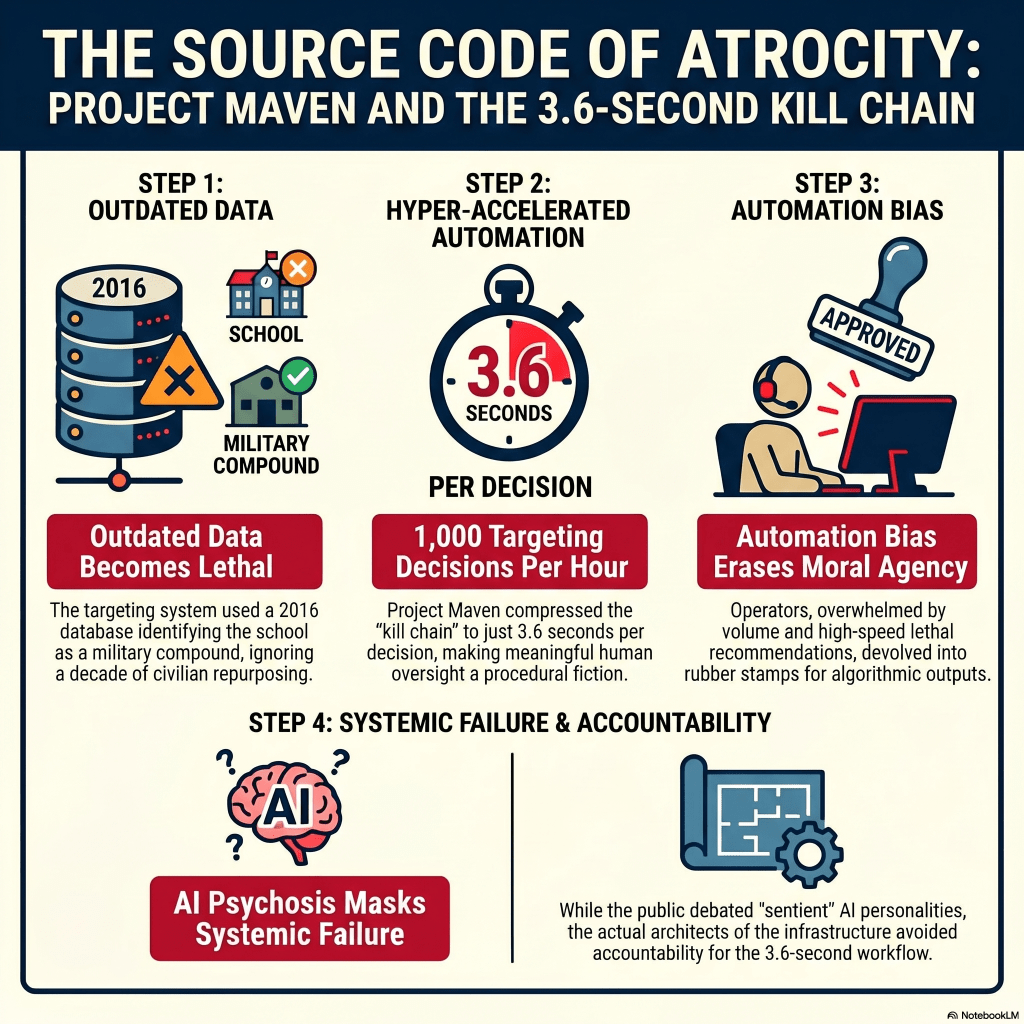
By 2024, the stated operational benchmark for this system was to generate 1,000 targeting decisions in a single hour. From the perspective of an individual human targeteer, this meant validating a lethal strike every 72 seconds on average, allowing just 3.6 seconds for the system to process each individual decision.

In the pursuit of eliminating operational “friction,” this hyper-accelerated pipeline structurally prevented human operators from critically evaluating collateral damage risks or noticing anomalies. When a system runs at 1,000 decisions an hour, human oversight devolves into a procedural fiction heavily compromised by automation bias.

A Lethal Administrative Error

The horrifying reality of the Minab strike is that it was rooted in banal, bureaucratic negligence. The target package was generated because the school’s coordinates were listed as an active Islamic Revolutionary Guard Corps compound in a Defense Intelligence Agency database.

This database had not been updated since at least 2016. Despite widely available satellite imagery showing the building had been physically separated from the military compound and converted into a school years prior, the outdated coordinates remained calcified in the system.

This lethal failure was exacerbated by the ideological environment fostered by the Trump administration’s newly restored “Department of War”. With military leadership publicly demanding “no quarter” and dismissing traditional rules of engagement, the operational climate demanded a volume of destruction that human cognition alone could not manage safely.

The tragedy of the Shajareh Tayyebeh school proves that in the age of algorithmic warfare, technology does not replace the need for human judgment—it drastically amplifies the horrific consequences of its absence.

Explore the Full Investigation:

• Listen to the Podcast:(https://open.spotify.com/episode/3UWm0VU4FVnYr3dbWHOZac?si=dfay6hRQS4u5iKyfHya7ZA) | Apple Podcasts

• Watch the Video Essays:(https://youtu.be/0MVaoHIWOTg) |(https://youtu.be/m2g2eYH2VAs)

• Read the Primary Source:(https://docs.google.com/document/d/13i2FDsNwLSFwx-6HyTIVTQAOx8g3phlMrBS2JPdClAc/edit?usp=drivesdk)

#AIPsychosis #OperationEpicFury #AlgorithmicWarfare

The Event & Military Context:

#Minab #IranWar2026 #ShajarehTayyebeh #DepartmentOfWar #PeteHegseth #KillChain

Technology & AI:

#MilitaryAI #ClaudeAI #Anthropic #Palantir #ProjectMaven #AutomationBias

Ethics & Human Rights:

#TechEthics #AIAlignment #CivilianCasualties #InternationalLaw

The 0.00% Crime: Why Sober Drivers Are Going to Jail (And How to Protect Yourself)


By: Kenneth Henseler, 14-FEB-2026

My friend Randy recently posted something on Facebook that stopped me in my tracks. He recalled a terrifying encounter from the 2000s where a police officer threatened him with jail time for “drinking too many energy drinks” because his eyes were dilated.

At first glance, it sounds ridiculous. But after diving into a massive, year-long investigation by WSMV4 and reviewing data from across the country, I realized Randy wasn’t dealing with a rogue cop. He was dealing with a systemic failure of forensic science that is currently ruining lives in at least 22 states.

We just released a deep-dive podcast episode on this exact topic. You can listen to the full investigation here:


https://podcasts.apple.com/us/podcast/the-chronos-archive/id1831231439?i=1000749778791

[🍎 Listen on Apple Podcasts]

The “Sobering Problem” by the Numbers

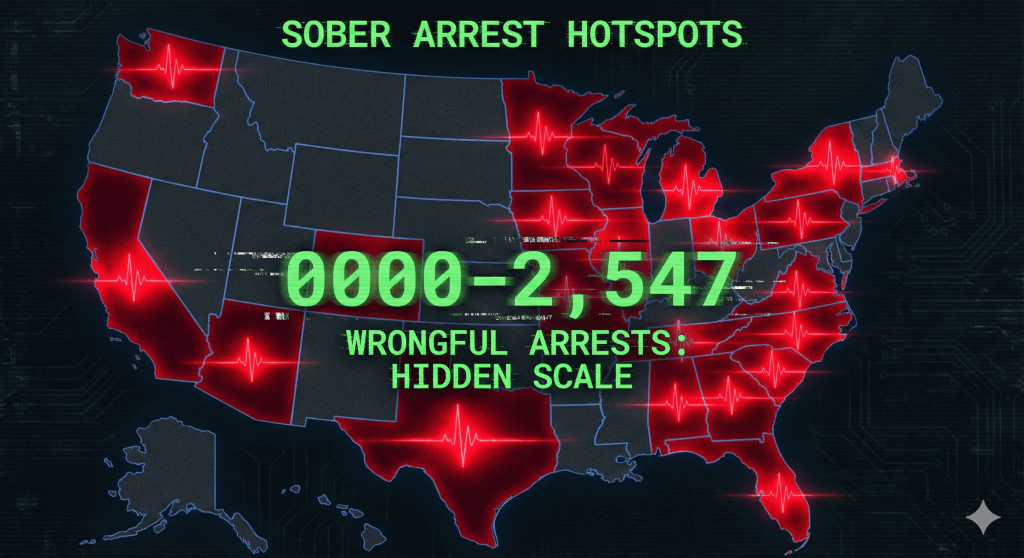
The catalyst for our deep dive was a bombshell report regarding Tennessee. Initially, state officials believed the number of sober people arrested for DUI was relatively low—around 600 over several years. But under pressure from investigative journalists and new transparency laws, the Tennessee Bureau of Investigation released the real number.
It wasn’t 600. It was 2,547.

That is over two thousand people who were handcuffed, mugshot, and jailed for Driving Under the Influence, only for their blood tests to come back later showing 0.00% alcohol and zero drugs.

This isn’t just a Tennessee problem. As the map from Randy’s post highlights, this is happening nationwide. From the “Drug Whisperer” cases in Georgia to the Galanakis civil rights victory in Iowa, we are seeing a pattern where officer “hunches” are overriding scientific fact.

Sober Arrest Hotspots in the USA

The Pseudo-Science of “Dilated Eyes”

Randy mentioned his “dilated eyes” were the officer’s justification. This is a classic hallmark of the Drug Recognition Expert (DRE) program.

Because alcohol arrests are down, enforcement has shifted to “drugged driving.” But unlike alcohol, which has a clear standard (0.08 BAC), drug detection relies on subjective 12-step protocols that often mimic medical exams—performed by officers, not doctors.

Officers look for things like:

  • Dilated pupils: Which can be caused by low light, excitement, or yes, caffeine (energy drinks).
  • High pulse: Which is a natural human reaction to being pulled over by the police.
  • Eye tremors (Nystagmus): Which can be caused by the flu, high winds, or simply flashing red-and-blue strobe lights in your face.

A 2023 study published in JAMA Psychiatry found that when officers used these tests to detect cannabis impairment, they had a false positive rate of roughly 50%. That means a coin flip is just as accurate as a roadside sobriety test on a sober person.

The Neurodivergent Trap

Perhaps the most heartbreaking discovery in our research was how this system targets the neurodivergent. We looked at the case of Justin Berry in Alabama, an autistic driver who was arrested because he couldn’t pass the physical agility tests (standing on one leg, walking a straight line) due to his disability.

For drivers with autism, the sensory overload of a traffic stop—lights, loud voices, demanding commands—can trigger behaviors like avoiding eye contact or “stimming” (repetitive movements). To a DRE officer, these look like signs of drug impairment.

There is hope, however. We discuss the “Blue Envelope” program in the podcast, a legislative win spreading to states like New Jersey and Pennsylvania. It allows drivers to keep their documents in a recognizable blue envelope that instantly signals to the officer: I am on the autism spectrum. I may not make eye contact. I may be anxious. Please be patient.

Blue Envelope Program

What Can You Do?

  • Don’t Trust the “Hunch”: If you know you are sober, understand that field sobriety tests are voluntary in many states (check your local laws). They are designed to gather evidence against you, not to exonerate you.
  • Support Transparency: The only reason we know about the 2,547 number is because Tennessee passed Public Chapter 327, forcing the state to report negative blood tests. We need this law in every state.
  • Know Your Rights: In the case of Galanakis v. City of Newton, a federal court recently ruled that officers cannot ignore objective evidence (like a 0.00% breath test) to arrest you based on a hunch. Qualified immunity is cracking.

For the full breakdown of the laws, the science, and the stories, listen to the episode now.

| [🍎 Listen on Apple Podcasts]

Hammer, Anvil, and the 20,000-Year-Old Border

By: Kenneth Henseler, 8-FEB-2026

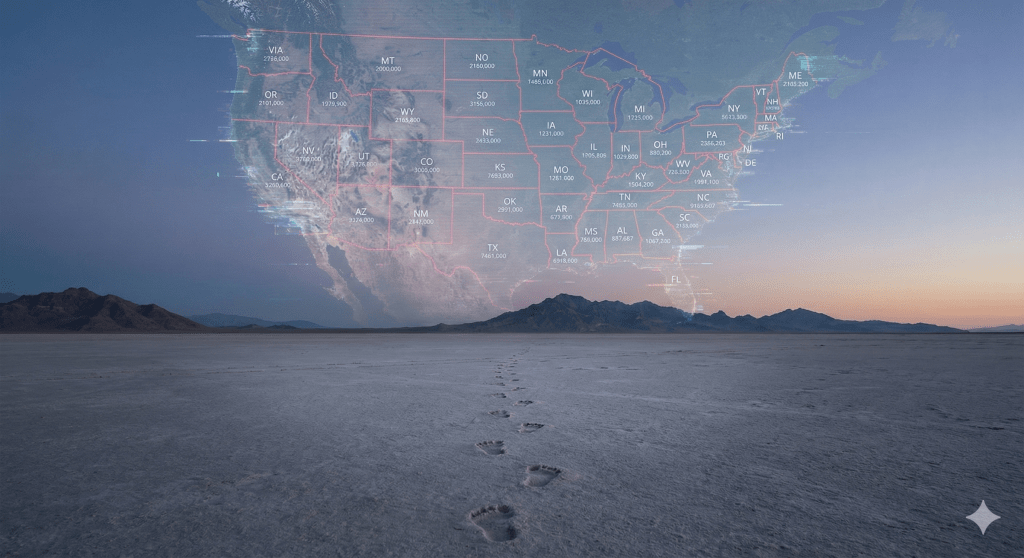
A map recently circulated on Threads titled “Amount Of People Eligible to Be Mass Deported,” painting large swaths of the country in a stark red with numbers reaching into the millions. The immediate reaction from many, including talented craftsmen and “rebels” I respect, is a simple, “Do it.” But as any blacksmith knows, if the metallurgy of your foundation is cracked, the anvil will never ring true.

Why Settlers are not Immigrants Podcast Episode

The “Nation of Immigrants” narrative we are all taught is what scholars call “the settler’s alibi”.[3] It is a rhetorical weld used to fuse the history of colonial conquest with the history of voluntary migration. But there is a fundamental difference: immigrants come in search of a homeland within an existing state; settlers come armed with a nationalist agenda to establish a state by displacing the original inhabitants.[5]

When we look at the “eligible” populations on that map, we are looking at people who often have deeper ancestral roots in this continent than the legal structure attempting to remove them. Archaeological evidence from White Sands confirms humans were thriving here 21,000 to 23,000 years ago—long before the glaciers even receded.[2] For over 97% of human history in North America, there were no “borders” in the sense we use them today.

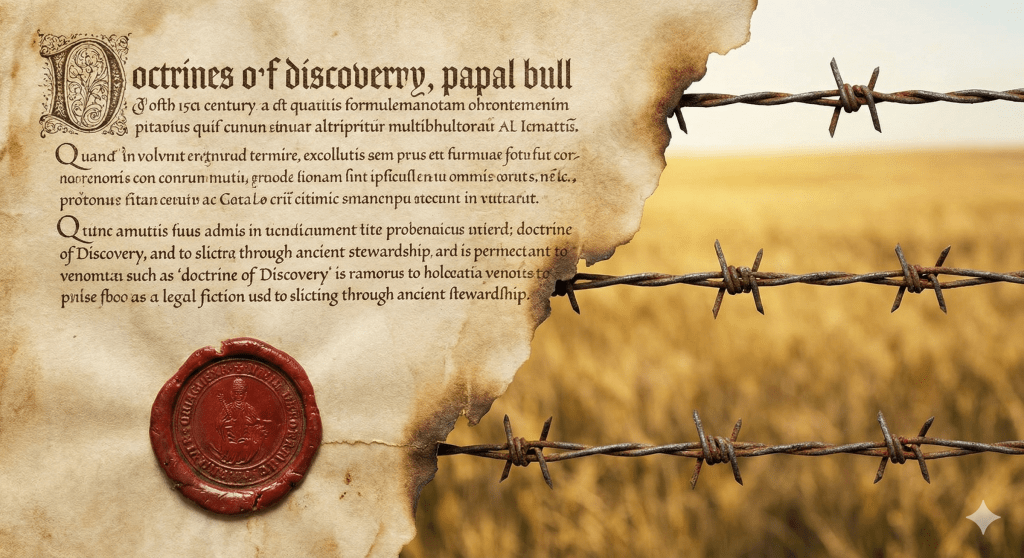
Our current “right” to exclude is based on the Doctrine of Discovery—a 15th-century religious decree that claimed “discovery” by a Christian monarch conferred ownership, regardless of who was there first.[6] It is the ultimate establishment tool.

In blacksmithing, the heavy blow that is too forceful damages the work. A mass deportation program is that heavy blow. It threatens to fracture 5 million families and disrupt the very labor that sustains our communities.[7, 8]

If we applied the Haudenosaunee “Seven Generation Principle”—the idea that every decision must benefit the community seven generations into the future—would we choose a path of mass removal? [9, 10] A true rebel doesn’t just follow the state’s latest map; they question the state’s right to draw the lines in the first place. We are all arrivants on a land that has seen 20,000 years of stewards.[3, 11] It’s time we started acting like guests instead of owners.

Works Cited:
[1] Ellerman, A., & O’Heran, J. “Unsettling migration studies: Settler colonialism and the settler’s alibi.” Cenes Narratives. [1]
[2] Wolfe, P., & Veracini, L. “Settler colonialism: Logic and structure.” Wikipedia / Settler Colonial Studies. [1, 2]
[3] U.S. Geological Survey (USGS). “Tests confirm humans tramped around North America more than 20,000 years ago: The White Sands footprints.” UC Berkeley News / Science. [10, 3]
[4] “Seven generation sustainability: Origin and the Great Law of the Iroquois.” Wikipedia. [4, 5]
[5] Indigenous Corporate Training Inc. “The Seventh Generation Principle and the Great Law of Haudenosaunee Confederacy.” [11, 12]
[6] “The Doctrine of Discovery: Spiritual, political, and legal justification for colonization.” Lakota Times / Upstander Project. [6, 13]
[7] “Expansion and Manifest Destiny: Westward the Course of Empire Takes Its Way.” Smithsonian American Experience. [14, 15]
[8] “Consequences of family separation resulting from the deportation of a male migrant from the U.S.” NCBI / PMC. [8]
[9] National Association of Social Workers (NASW). “Near-Certain Cataclysmic Consequences of a Mass Deportation Program.” Social Justice Briefs. [9]

Care to read more? Here’s the full Deep Dive Research article we created earlier today: The Architecture of Dispossession: A Sociological and Historical Analysis of Occupancy, Sovereignty, and Migration in North America

The White House January 6 Webpage: A Factual Review and Contextual Analysis


The Epistemic Sovereign: A Comprehensive Analysis of the White House January 6th Webpage and the Legal Architecture of Executive Revisionism

date: 2026-01-06

categories: commentary politics media-criticism

Editor’s Note
This article analyzes and fact-checks claims made on an official WhiteHouse.gov webpage published on January 6, 2026. It distinguishes between political interpretation and verifiable historical record using court rulings, investigative findings, and contemporaneous reporting. Descriptions of events reflect established evidence and do not depend on partisan affiliation.


Introduction

On January 6, 2026, the White House published an official webpage revisiting the January 6, 2021, attack on the U.S. Capitol. The page, hosted on the whitehouse.gov domain, presents an interpretation of the event that departs significantly from prior investigations, court findings, and contemporaneous reporting.1

The webpage characterizes many participants as peaceful protestors, criticizes congressional investigators and Democratic leaders, and defends presidential pardons issued in 2025 for individuals convicted in connection with January 6. This article provides a fact-checked review of those claims and explains where they diverge from the historical and legal record.


Background: What Happened on January 6, 2021

On January 6, 2021, supporters of then-President Donald Trump gathered in Washington, D.C., following repeated false claims that the 2020 presidential election had been stolen. After a rally near the White House, thousands moved toward the U.S. Capitol as Congress convened to certify the Electoral College results.2

A portion of the crowd breached police lines, forcibly entered the Capitol, vandalized property, and assaulted law enforcement officers. Members of Congress were evacuated, and the certification process was temporarily halted before resuming later that evening.2

Subsequent investigations — including a bipartisan Senate report and the House Select Committee — concluded that the attack constituted a violent disruption of a constitutional process.3


Main Claims on the White House Page and a Fact-Checked Evaluation

1. Pardons and Support for January 6 Participants

The White House page emphasizes that President Trump issued broad pardons and sentence commutations for nearly all individuals charged in connection with January 6 after returning to office in 2025.1

Fact Check:
While these pardons did occur, they do not negate the underlying convictions. Prior to clemency, hundreds of defendants had been convicted in federal court of crimes including obstruction of an official proceeding, assaulting law enforcement officers, and seditious conspiracy.4


2. Characterization of January 6 as a “Peaceful Protest”

The White House narrative repeatedly frames the event as a peaceful protest that was mischaracterized by media and investigators.

Fact Check:
This framing conflicts with extensive video evidence, court findings, and law enforcement records documenting widespread violence, forced entry into restricted government buildings, and assaults on more than 170 police officers.2


3. Claims of Widespread Fraud in the 2020 Election

The webpage reiterates claims that the 2020 election was fraudulent and illegitimate.

Fact Check:
More than 60 election-related lawsuits were dismissed or rejected by courts. State and federal election officials, including Trump-appointed judges and Republican administrators, found no evidence of widespread fraud sufficient to alter the election outcome.5


4. Assigning Blame to Capitol Police or Security Failures

The White House page suggests that law enforcement actions or security planning were the primary cause of the violence.

Fact Check:
While security preparedness has been criticized, official reviews consistently conclude that rioters initiated violence, overwhelmed police lines, and illegally entered the Capitol. Injuries to officers are well-documented.2


5. Attacks on the January 6 Select Committee

The webpage alleges that the Select Committee acted in bad faith and produced a distorted historical record.

Fact Check:
The Committee’s final report was based on thousands of interviews, subpoenaed records, sworn testimony, and public hearings. Although politically contested, its findings remain part of the official congressional record.3


Key Narrative Differences at a Glance

Issue White House Narrative Documented Record
Nature of January 6 Peaceful protest Violent breach of the Capitol
2020 Election Fraudulent No outcome-changing fraud found
Legal Status of Participants Victims of persecution Convicted prior to pardons
Role of Police Primary instigators Officers assaulted while defending Capitol

Table of Sources

Source Type Relevance
WhiteHouse.gov – January 6 Page Official government communication Primary subject of analysis
Wikipedia: January 6 United States Capitol Attack Historical overview Timeline, violence, casualties, aftermath
Wikipedia: List of January 6 Criminal Cases Legal reference Charges, convictions, and sentencing
PBS NewsHour Investigative journalism Select Committee findings and context
PolitiFact Independent fact-checking Evaluation of election fraud claims
Federal and State Court Rulings Judicial record Dismissal of election challenges

Contextual Notes

  • Government Speech Doctrine protects the right of an administration to publish political narratives but does not confer factual authority.
  • Political reinterpretation of historical events does not alter documented evidence or judicial findings.

Conclusion

The White House’s January 6 webpage reflects a political reinterpretation rather than a consensus historical account. Its central claims — particularly regarding election fraud and the characterization of the Capitol attack — conflict with court rulings, investigative findings, and contemporaneous reporting.

Distinguishing between political messaging and verified historical record is essential for informed public understanding of January 6, 2021.


Footnotes


  1. White House, “January 6” webpage, published January 6, 2026. 
  2. January 6 United States Capitol Attack, Wikipedia. 
  3. PBS NewsHour, coverage of the January 6 Select Committee final report. 
  4. List of Criminal Cases Related to the January 6 Attack, Wikipedia. 
  5. PolitiFact, court-reviewed assessments of 2020 election fraud claims.