
Viral Fiction vs. Thermodynamic Fact: The Truth About AI Data Center Cooling

By Kenneth Henseler, 20-FEB-2026

If you spend enough time scrolling through Instagram or TikTok, you are bound to encounter highly alarming statistics about the environmental impact of artificial intelligence. Recently, a reel posted by the user ‘bizbrat’ went viral, featuring a dark, ominous video of an industrial grate accompanied by a startling text overlay: “800 BILLION litres of fresh water is being used in a single DAY to cool down systems across the world, concerning or not?”

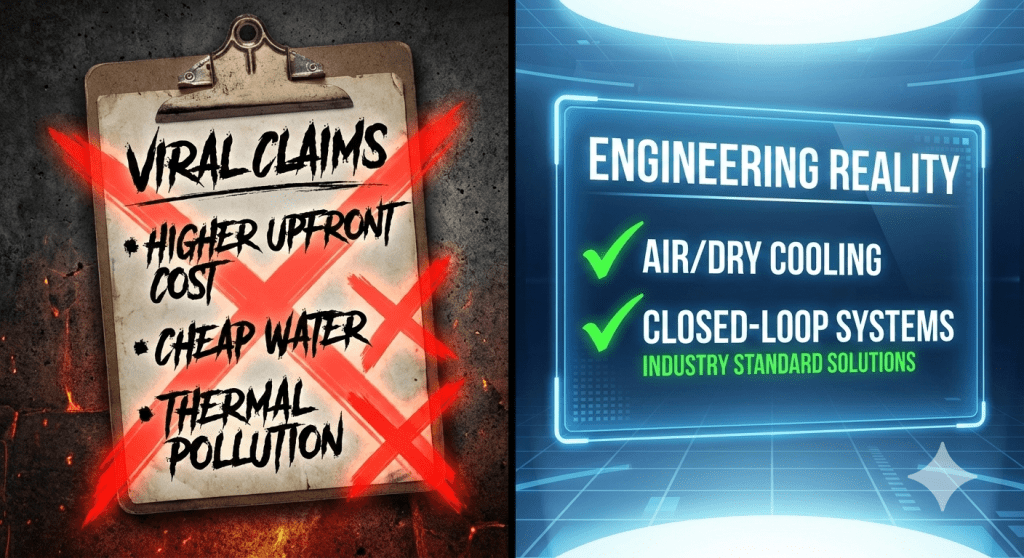
The caption went further, claiming that 11 trillion liters of water are used for this purpose overall, and alleging that companies refuse to use “Air/dry cooling” or “Closed-loop systems” because of “Higher upfront cost” and “Water is cheap & under-regulated.” Most alarmingly, the post claimed that hot water is routinely dumped into water bodies, killing organisms and causing severe “thermal pollution.”
To understand why this video exists, we have to look at the digital economy. In 2025, Oxford University Press named “rage bait” as its Word of the Year.[1] Defined as online content deliberately engineered to provoke anger, frustration, or moral outrage to artificially inflate engagement, the usage of the term tripled as the digital landscape became increasingly charged.[1] The claims in this specific video are a textbook example of this phenomenon—taking fragmented, outdated concepts and presenting them as modern crises to harvest outrage for algorithmic profit.[2]

The most egregious claim in the reel’s caption is the idea of “thermal pollution”—the assertion that “hot water is sometimes put into water bodies which kills many organisms.” While thermal pollution is a legitimate historical and regulatory concern for mid-century nuclear or coal power plants that utilize open-loop river cooling, modern enterprise data centers operate under entirely different engineering paradigms.
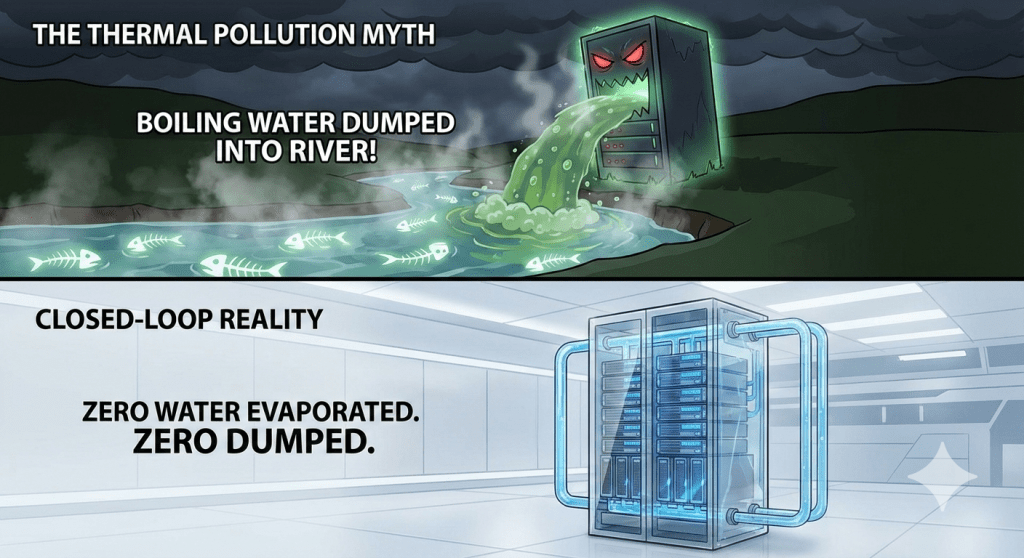
Furthermore, the irony of the video is that the exact solutions it demands—air/dry cooling and closed-loop systems—are already the standard for high-tier enterprise infrastructure.

To ground this in reality, we can look at the NTT Global Data Centers TX1 facility in Garland, Texas. This 230,000-square-foot fortress supports 16 Megawatts of critical IT load.[3] Does it evaporate billions of liters of water daily? No. The official specifications of the TX1 facility explicitly state that it utilizes “waterless cooling using indirect air exchange cooling technology” driven by 74 total rooftop cooling units.[4]

As artificial intelligence pushes server rack power densities from standard 10kW loads up to 100kW or even 200kW, the industry is shifting toward liquid cooling.[5] However, these are fundamentally closed-loop systems. Whether utilizing Direct-to-Chip cold plates or full immersion cooling, the liquid is sealed within the system.[6] These liquid systems are highly sustainable, capable of reducing data center energy consumption by over 60% and up to 95% in optimized setups.[7]

The technology to run massive computational loads sustainably doesn’t just “exist” as a hypothetical—it is currently powering the global digital economy. The next time a viral video tries to tell you the internet is boiling the oceans, remember that outrage is free, but good engineering is a closed loop.

🍎 Podcasts: https://podcasts.apple.com/us/podcast/the-chronos-archive/id1831231439?i=1000750756195

Sources Cited:

  • Oxford Word of the Year 2025: Rage Bait [1]
  • NTT Global Data Centers TX1 Specifications [5, 4]
  • The Mechanics of Kyoto Cooling [6, 7]
  • Liquid vs. Air Cooling in High-Density AI Data Centers [8, 9]
  • Understanding Data Center Water Consumption [2, 3]

From Ticket-Taking to Platform-Building: Why We Are Pivoting to Product Mode

A Platform Engineering Manifesto

By: Kenneth Henseler, 15-FEB-2026

I’ve spent a lot of time in the trenches of IT Infrastructure. If you’ve been there, you know the drill: The “Ticket Factory.”

Developers need a server? Ticket.

Need a firewall rule? Ticket.

Need a database? Ticket.

For decades, this was the industry standard. It was safe. It was controlled. But in 2026, it’s also a bottleneck that kills velocity. When your smartest engineers spend 60% of their week manually executing repetitive tasks from a queue, you aren’t managing infrastructure—you’re managing a bureaucracy.

That’s why I’m leading a strategic shift in my organization: Moving from IT Service Management (ITSM) to Platform Engineering. We call it Project Polaris.

Here is the philosophy behind the shift, and why “Good IT” isn’t about closing tickets anymore—it’s about building products.

1. The “Ticket Factory” Doesn’t Scale

Traditional IT operations are linear. If you hire 10 more developers, you generate 10x more requests, which means you need 10x more sysadmins to handle the load. That math doesn’t work.

We are moving away from being “Gatekeepers” (who approve and implement) to becoming “Gardeners” (who cultivate the ecosystem).

The goal of our new Platform Engineering model is simple: Self-Service with Guardrails.

We are building an Internal Developer Platform (IDP) that treats our infrastructure as a product. If a developer needs a resource, they shouldn’t have to ask me for permission; they should be able to consume it via API or portal, knowing that the security and compliance checks are already baked in.

2. The “Golden Ratio” of Capacity Planning

One of the hardest lessons in engineering leadership is protecting your team’s time. If you don’t defend it, “keeping the lights on” (KTLO) will eat 100% of your bandwidth.

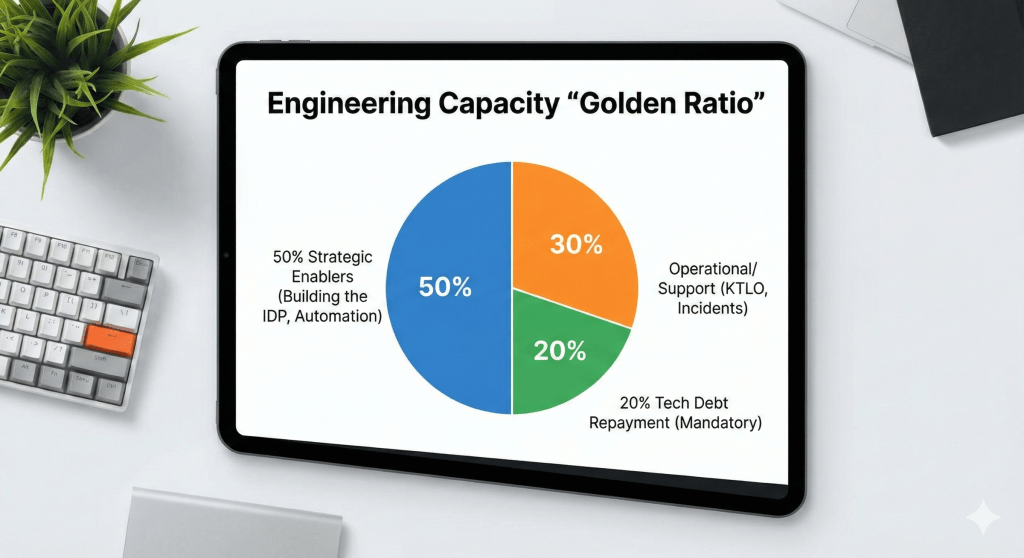
As part of this restructure, we are implementing a strict capacity model that I call the “Golden Ratio” for our sprints:

• 50% Strategic Enablers: Work that moves the business forward (Building the IDP, new architecture, automation).

• 30% Operational/Support: The inevitable day-to-day reality of running systems.

• 20% Tech Debt Repayment: Mandatory. Non-negotiable.

If you don’t explicitly budget for Tech Debt, you are essentially taking out a high-interest loan on your future stability. Eventually, the interest payments (outages, slow deployments, manual patches) will bankrupt your time.

3. Governance as Code (Safety Without Speed Bumps)

The biggest fear with self-service is usually security. “If we let devs provision their own DBs, won’t they leave them open to the internet?”

In the old world, we stopped this by having a human review every change. In the Platform world, we stop this with Governance as Code.

Instead of a manual approval board, we define our policies in the platform itself.

• You want an S3 bucket? Fine, but the platform automatically enforces encryption and private access policies before it’s even created.

• You need a VM? The image is pre-hardened and automatically patched.

We aren’t removing the rules; we are automating the enforcement. This allows us to say “Yes” faster, without lowering our security posture.

The North Star, Polaris

This transition isn’t easy. It requires a culture shift from “I own this server” to “I own the code that builds this server.”

But the destination is worth it. By treating our platform as a product, we stop being the “Department of No” and start being the accelerator that the business actually needs.

See you in the server room (or the repo).

– Ken

Hammer, Anvil, and the 20,000-Year-Old Border

By: Kenneth Henseler, 8-FEB-2026

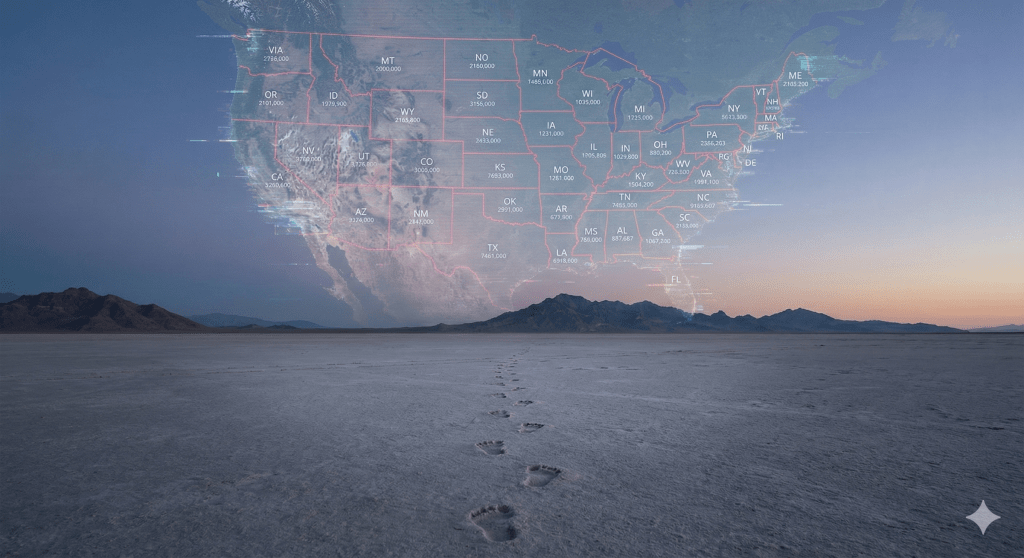
A map recently circulated on Threads titled “Amount Of People Eligible to Be Mass Deported,” painting large swaths of the country in a stark red with numbers reaching into the millions. The immediate reaction from many, including talented craftsmen and “rebels” I respect, is a simple, “Do it.” But as any blacksmith knows, if the metallurgy of your foundation is cracked, the anvil will never ring true.

Why Settlers are not Immigrants Podcast Episode

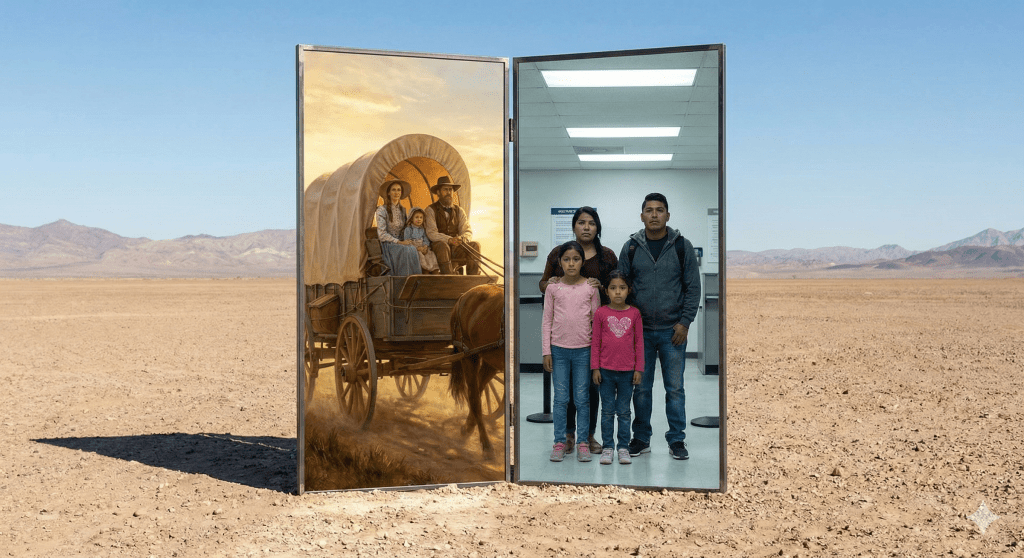
The “Nation of Immigrants” narrative we are all taught is what scholars call “the settler’s alibi”.[3] It is a rhetorical weld used to fuse the history of colonial conquest with the history of voluntary migration. But there is a fundamental difference: immigrants come in search of a homeland within an existing state; settlers come armed with a nationalist agenda to establish a state by displacing the original inhabitants.[5]

When we look at the “eligible” populations on that map, we are looking at people who often have deeper ancestral roots in this continent than the legal structure attempting to remove them. Archaeological evidence from White Sands confirms humans were thriving here 21,000 to 23,000 years ago—long before the glaciers even receded.[2] For over 97% of human history in North America, there were no “borders” in the sense we use them today.

Our current “right” to exclude is based on the Doctrine of Discovery—a 15th-century religious decree that claimed “discovery” by a Christian monarch conferred ownership, regardless of who was there first.[6] It is the ultimate establishment tool.

In blacksmithing, the heavy blow that is too forceful damages the work. A mass deportation program is that heavy blow. It threatens to fracture 5 million families and disrupt the very labor that sustains our communities.[7, 8]

If we applied the Haudenosaunee “Seven Generation Principle”—the idea that every decision must benefit the community seven generations into the future—would we choose a path of mass removal? [9, 10] A true rebel doesn’t just follow the state’s latest map; they question the state’s right to draw the lines in the first place. We are all arrivants on a land that has seen 20,000 years of stewards.[3, 11] It’s time we started acting like guests instead of owners.

Works Cited:
[1] Ellerman, A., & O’Heran, J. “Unsettling migration studies: Settler colonialism and the settler’s alibi.” Cenes Narratives. [1]
[2] Wolfe, P., & Veracini, L. “Settler colonialism: Logic and structure.” Wikipedia / Settler Colonial Studies. [1, 2]
[3] U.S. Geological Survey (USGS). “Tests confirm humans tramped around North America more than 20,000 years ago: The White Sands footprints.” UC Berkeley News / Science. [10, 3]
[4] “Seven generation sustainability: Origin and the Great Law of the Iroquois.” Wikipedia. [4, 5]
[5] Indigenous Corporate Training Inc. “The Seventh Generation Principle and the Great Law of Haudenosaunee Confederacy.” [11, 12]
[6] “The Doctrine of Discovery: Spiritual, political, and legal justification for colonization.” Lakota Times / Upstander Project. [6, 13]
[7] “Expansion and Manifest Destiny: Westward the Course of Empire Takes Its Way.” Smithsonian American Experience. [14, 15]
[8] “Consequences of family separation resulting from the deportation of a male migrant from the U.S.” NCBI / PMC. [8]
[9] National Association of Social Workers (NASW). “Near-Certain Cataclysmic Consequences of a Mass Deportation Program.” Social Justice Briefs. [9]

Care to read more? Here’s the full Deep Dive Research article we created earlier today: The Architecture of Dispossession: A Sociological and Historical Analysis of Occupancy, Sovereignty, and Migration in North America

The Ghost in the Machine: Finding Reality Between the Pings

Your life without a computer: what does it look like?

There are two versions of my home. The first is digital. It’s the steady glow of monitors, the hum of servers, the relentless flow of information where I feel native, capable, and in control. To borrow a term, it’s where I’m “jacked in.” It’s my virtual home, and in many ways, it’s where I feel I belong.

The second home is the one I have to consciously choose to inhabit. It’s the world outside the screen, the one that exists between the pings of notifications. This writing prompt sent me down two very different paths: a look at the life I never lived, and a closer examination of the life I fight for every day when the devices are down.

Part 1: The Craftsman from a Small Town

Before the command line, there was the county line. My childhood was grounded in the tangible world of my small Indiana hometown. It smelled like sawdust from my Gramp’s basement woodshop and felt like the bumpy ride in his yellow Willey’s CJ7. It was the meticulous patience of setting up an HO scale model train and the simple joy of family camping trips. My identity was forged by things I could hold: a football, a wrestling singlet, a block of wood. I learned teamwork, discipline, and the quiet satisfaction of a job well done.

In this world, my innate desire to “fix broken stuff” would have manifested differently. I can see him clearly, this ghost of a man I might have been. He might have become a craftsman or a tradesman, his hands calloused from work, not carpal tunnel. His community would have been smaller, but perhaps deeper—rooted in the physical connections of our Boy Scout troop, church youth group, and school friends. His worldview, shaped by a complete set of Encyclopedias on the bookshelf rather than the chaotic firehose of the internet, would have been more focused, more local.

But that’s not the path I took. The arrival of the family Atari 2600, my grandfather’s TI-99/4A, SNES and eventually the Nintendo 64 was a quiet but seismic shift. They were a gateway, a portal, and I ran through it.

That path wasn’t clean. The same technology that captivated my mind also tested my discipline. Endless nights of computer gaming destroyed my sleep routine, a habit that followed me to college, where I struggled academically my first year and had to change course. It was a harsh, direct consequence of my new digital life. Yet, that same digital life was my ticket out. Computers helped me move away from my hometown, building a career that took me from one city to the next, and eventually to my new home in the South. The craftsman stayed put; the digital native got to see the world. I gained opportunity and a broader perspective, but I sometimes wonder about the simpler, more grounded wisdom I may have left behind.

Part 2: Jacking Out of The Matrix

So, where does that leave me now? It leaves me here, in a digital home I’ve built over a lifetime. I regularly work 10-12 hour days in a demanding IT role, a world where you’re always on standby, where the pressure to be productive, deliver value, and maintain high availability of the platforms and systems is a constant hum beneath the surface. When I re-enter this world after a break, it feels natural, like coming home—unless it’s a production outage bridge, which is accompanied by a familiar sense of dread.

Knowing how immersive this world is, I have to be intentional about unplugging.

My escapes aren’t always grand vacations; they are small, conscious rebellions. It’s putting the phone down while I cook breakfast and brew coffee. It’s stepping onto the back patio between meetings just to feel the sun on my face. It’s walking the backyard after the last call of the day, being grounded, just taking it all in. No phones at the dinner table. These are my rules of engagement with the physical world.

The feeling of being offline is a strange cocktail of freedom and anxiety. On one hand, there is an immediate sense of release. I can feel the algorithms letting go of their grip, the targeted ads and curated outrage fading into the background. In their place, the real world emerges. I notice the bees on the flowers, the green anole lizards sunning themselves, the surprising number of stars I can see over my city despite the light pollution.

But there’s another feeling, too: a low-grade guilt for not being productive, a slight anxiety awaiting a comment in a group chat or the results of my latest blog post or YouTube video. It’s an internal tug-of-war between the demand to be connected and the deep-seated need to be present.

That’s where I find the ultimate reward. In those quiet moments, I am able to give my family the best version of myself. I can fully engage, actively listen, and participate in a conversation with my wife or a moment with my daughter. These are the moments that technology, for all its wonders, cannot replicate. They are the reason to disconnect.

In the end, this isn’t about choosing one life over the other. I can’t be the craftsman from my hometown anymore. I am the man who builds and fixes things in the digital world. But I can carry the ghost of that craftsman with me. I can choose to put down the tools of my trade, walk outside, and remember what it feels like to live in the real, physical, and beautifully analog world. The challenge isn’t learning to live without computers; it’s learning how to live a full life between the moments we are jacked in.